Light, Fire, Water and the Art of Evening Atmosphere
There is a particular point in early autumn when outdoor entertaining becomes more interesting than it was in summer. The heat loosens its grip, evenings arrive a little earlier, and the first suggestion of color appears in the trees. Dinner may still belong outdoors, but suddenly a shawl over the back of a chair, a lantern on the terrace and the first small fire begin to matter.
It is not yet the season of retreat. Quite the opposite. Early fall is one of the most rewarding moments to reconsider the outdoor room because the landscape itself begins doing more of the decorating. Light grows warmer, shadows lengthen, water starts reflecting rather than merely refreshing, and fire becomes useful as well as beautiful.
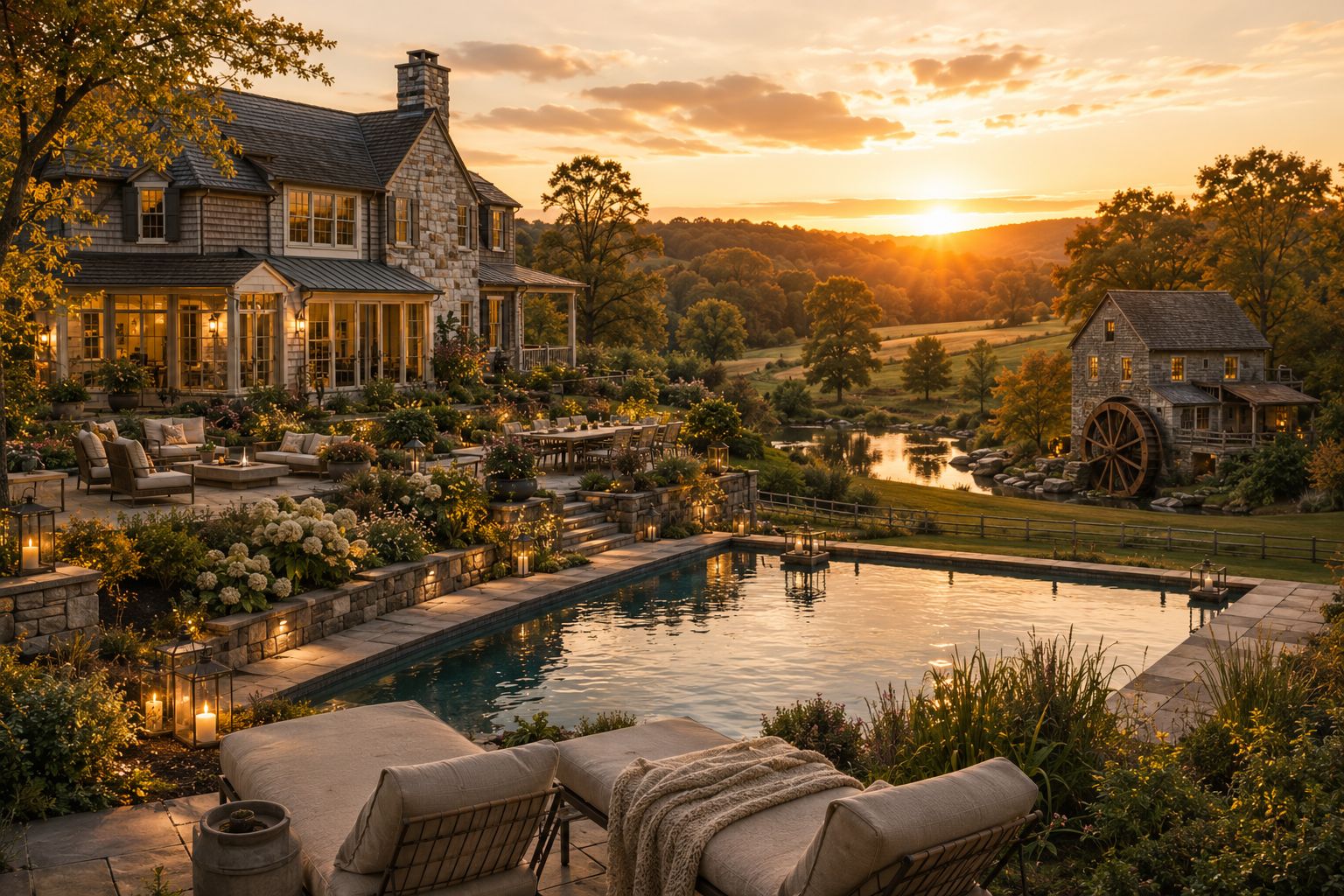
In the Pennsylvania countryside, an old stone house, a weathered mill, rolling fields and mature trees provide the historic weight against which contemporary furniture and modern materials can become especially compelling. The contrast is not something to disguise. It is the point: old architecture and new design sharpening one another, with the landscape holding the entire composition together.
Begin With a Sense of Place
Before selecting another chair, lantern or cushion, look beyond the terrace. What is already there? A successful outdoor room should feel as though it belongs to its landscape rather than having been placed on top of it. Here, substantial stone, weathered shingles, deep windows, garden walls, mature oaks and maples, and a meadow dropping toward water give the property a history before a single piece of furniture is introduced.
The house need not be grand. There is something more persuasive about a beautifully proportioned country house that feels attainable and lived in than an estate designed primarily to impress. Luxury can come from quality rather than scale: good stone, mature trees, an intelligently planned terrace, furniture proportioned to the architecture and lighting that reveals the landscape rather than flooding it.
This is where contemporary outdoor design becomes interesting. It does not need to mimic the traditional architecture. A restrained aluminum table beside an old stone wall can be more sophisticated precisely because it is different. The furniture becomes almost architectural; the old materials become more visible; neither has to surrender its identity.
The Dining Table as Architecture
One of the most underestimated decisions in an outdoor room is the dining table. It is not simply somewhere to put plates. As one of the largest uninterrupted horizontal planes in the composition, its proportion, color and material quietly influence the emotional temperature of the entire space.
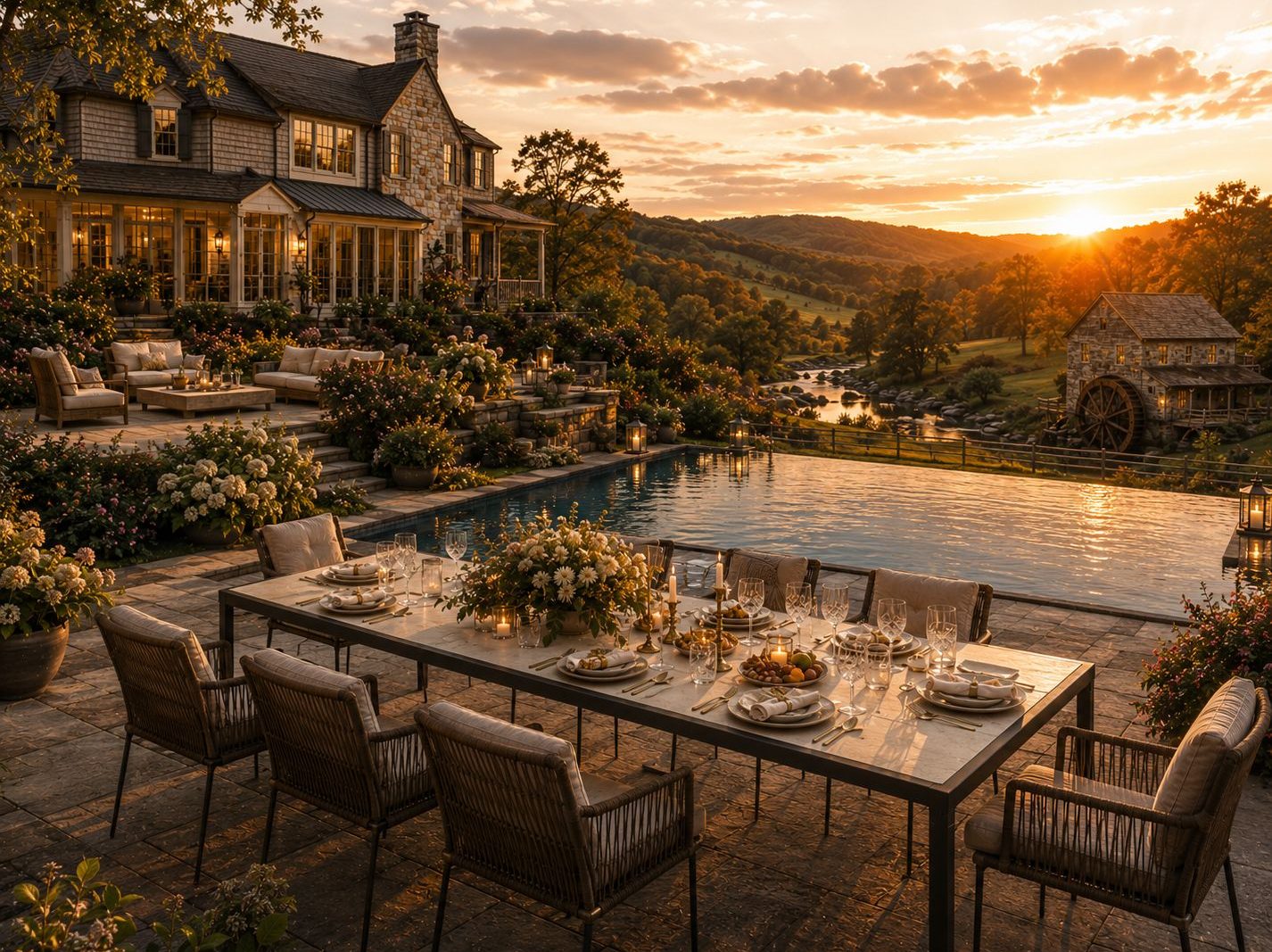
Seasonal Living’s Eterna dining table is especially effective here because its architecture is deliberately restrained: a dark aluminum frame, square-profile legs and a framed top composed of three Dekton panels with subtle join lines. In this Pennsylvania setting, the lighter Lunar surface introduces calm against stone, timber and an autumn landscape beginning to deepen in color. The dark aluminum edge gives the table definition without making it heavy.
The surface should remain visible. A full tablecloth would hide the very architecture that gives the piece its character. Linen napkins, clear or cut glass, low florals, candlelight and perhaps a restrained runner are enough to soften the mineral surface. Brass can add warmth; creams, greens, faded yellow, herbs and small branches can suggest the season without turning the table into a catalogue of autumn symbols. Fall does not have to announce itself with a pumpkin.
Repeat Materials, Not Furniture Sets
One of the quickest ways to make an outdoor space feel newly assembled is to make every piece match. A more enduring approach is to repeat relationships rather than products: material, proportion, tone and purpose. Seasonal Living describes this as the Design Continuum — different collections working together because they share a visual and functional language rather than because they came from the same family.
In this setting, Dekton Lunar becomes one of those quiet connective threads. The pale mineral language of the dining table can reappear at the outdoor kitchen and again around the pool edge. Not everywhere, and never insistently. The best repetition is recognition: you sense that the table, kitchen and pool belong together before you consciously understand why.
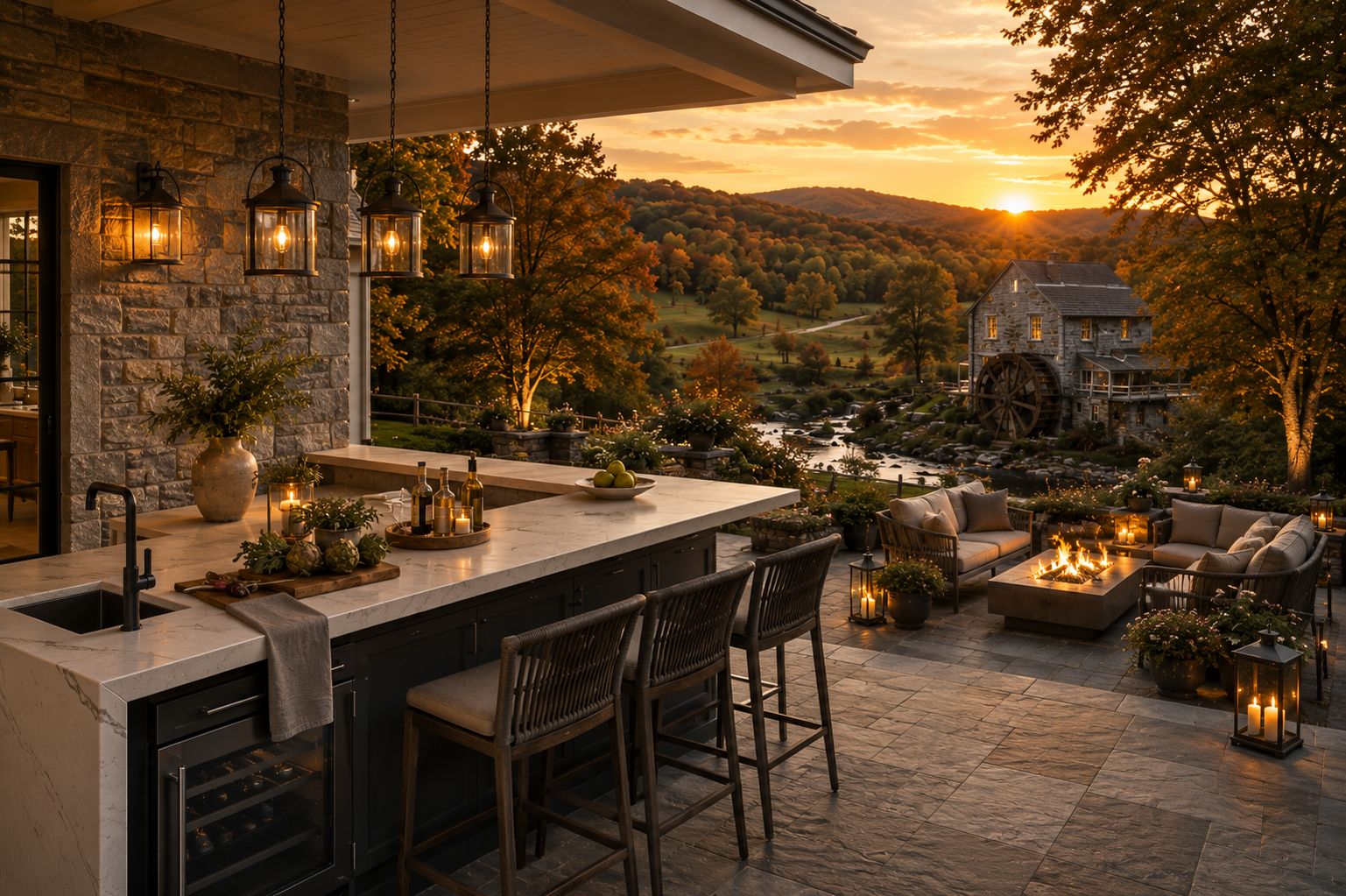
The outdoor kitchen then becomes part of the choreography of entertaining. Positioned close to the house, it keeps preparation connected to the gathering without allowing appliances to dominate the terrace. A long counter, storage, grill, sink and perhaps a refrigerator drawer or wine cooler are sufficient. The kitchen should remain architectural and relatively quiet; it should never look as though an indoor kitchen wandered into the garden.
As Daylight Fades, Design Changes
Summer terraces can rely almost entirely on daylight. Early autumn asks for more subtlety because the hour between late afternoon and evening becomes part of the experience. The most beautiful moment is often late golden light, when the sun is still doing most of the work but artificial illumination has just begun to register. Windows glow, lanterns appear, tree uplighting reveals trunks and branches, and fire starts to have presence while the landscape remains legible.
That balance matters. There will be time later in the season for darkness and drama. Early fall is more compelling when we can still see the hills, the stone, the changing trees and the surface of the water while the first layers of evening light begin to gather around them.
Water Becomes Art
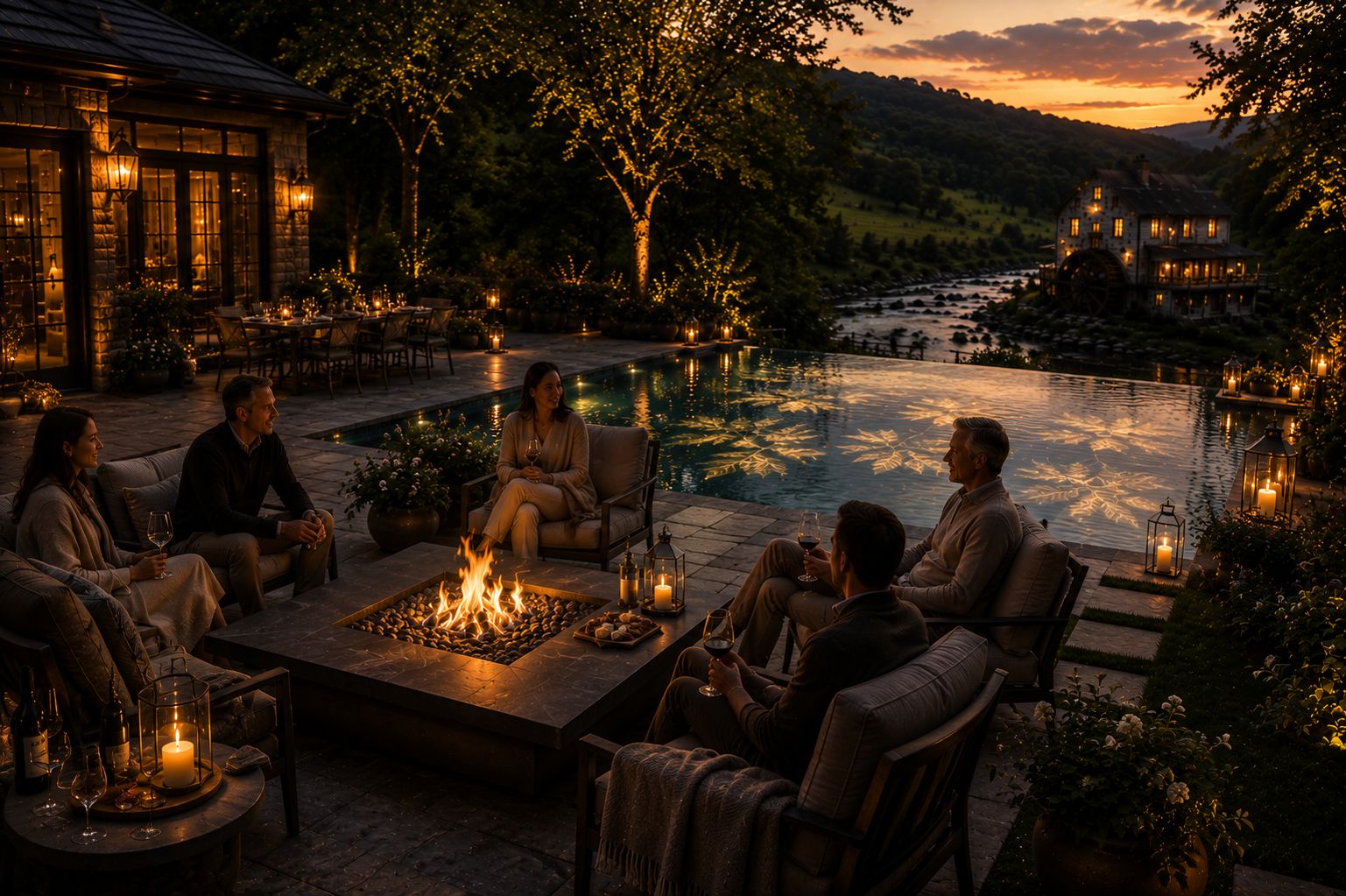
A swimming pool is often treated as a summer object, but in fall it can become something more interesting: a reflective plane within the landscape. Once swimming is no longer the principal activity, water becomes mirror, movement and atmosphere — a place where sky, trees, architecture and light begin interacting.
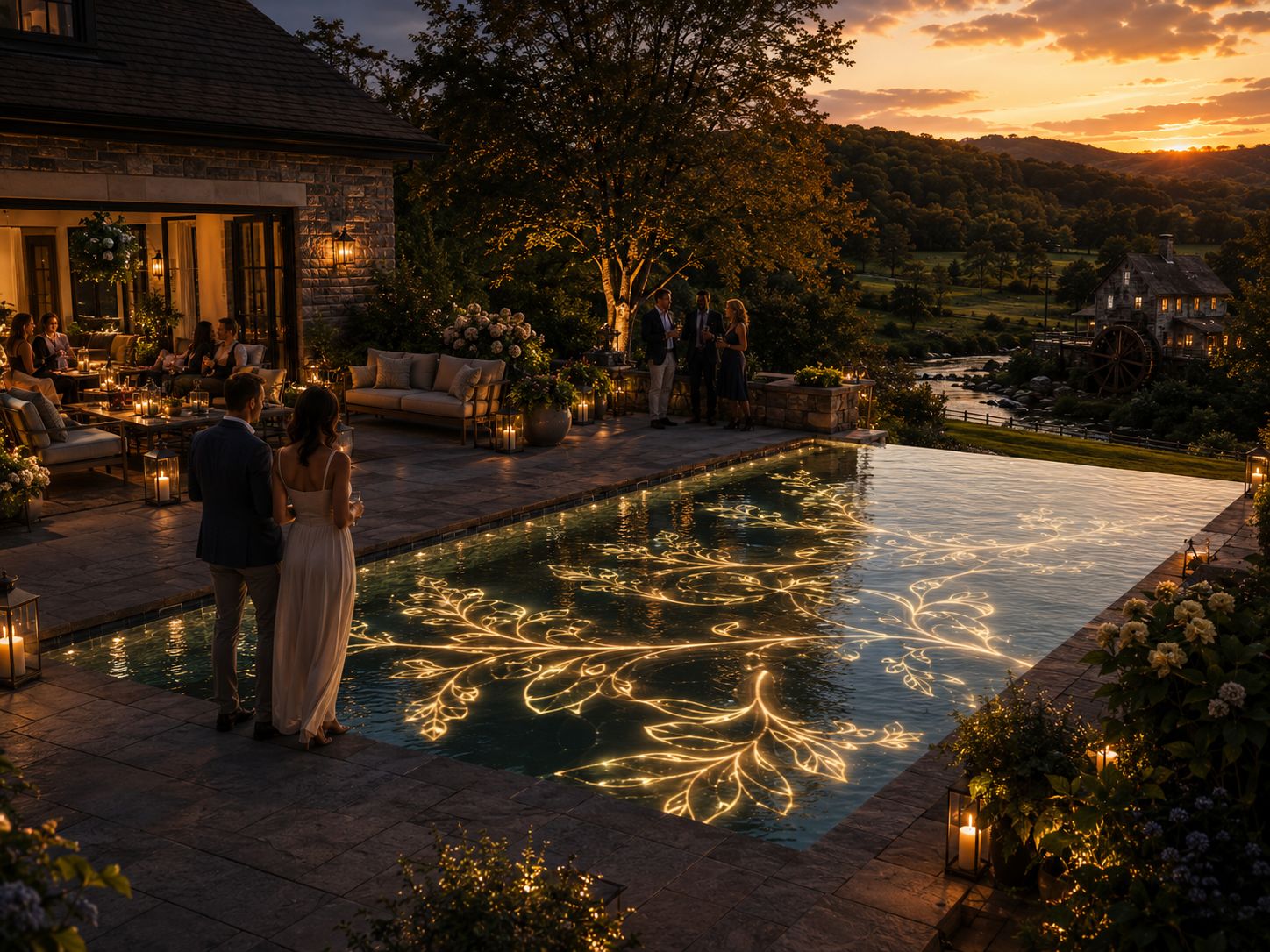
Projected light can make that transformation extraordinary, provided it behaves like light on water rather than decoration applied to it. A loose pattern of oak or maple leaves should stretch, fragment, disappear and return as the surface moves. Warm amber or pale gold relates naturally to autumn foliage and candlelight. The technology should remain discreet; at most, a faint suggestion of its source explains the effect without turning the projector itself into a feature.
Against old stone, mature trees and a historic landscape, contemporary light art is unexpected enough to feel magical. It should appear temporary, almost accidental — as though the landscape has begun drawing on the water.
Light the Landscape, Not Just the Terrace
Outdoor lighting often goes wrong when everything is illuminated equally. Selectivity creates depth. A beautiful tree may deserve uplighting; a stone wall may take a soft wash; a path needs only enough light to make movement comfortable. The remainder can stay relatively dark, allowing the eye to travel from candlelight at the table to a lit trunk, then into shadow, and perhaps finally to the old mill catching a small amount of architectural light in the distance.
This is when lighting stops being simply about visibility and becomes composition. Darkness is not an absence to eliminate. It is one of the materials with which the evening is designed.
Fire Is Social Architecture
Water creates reflection; fire creates congregation. People instinctively turn toward flame, which makes a fire feature less an accessory than a piece of social architecture. Placement therefore matters. A successful outdoor room has geography: dining belongs in one place, cooking near the house, and conversation somewhere else.
Here, the lounge sits closer to the house, where the architecture provides shelter and where people naturally migrate once dinner is finished. This is also where the furniture can become more relaxed —deeper cushions, throws over chair backs, low tables, a bottle of wine and perhaps coffee later. The fire need not be enormous. Smaller is often better because people can sit close enough to one another to talk. The objective is not spectacle. It is intimacy.
The Other Kind of Water
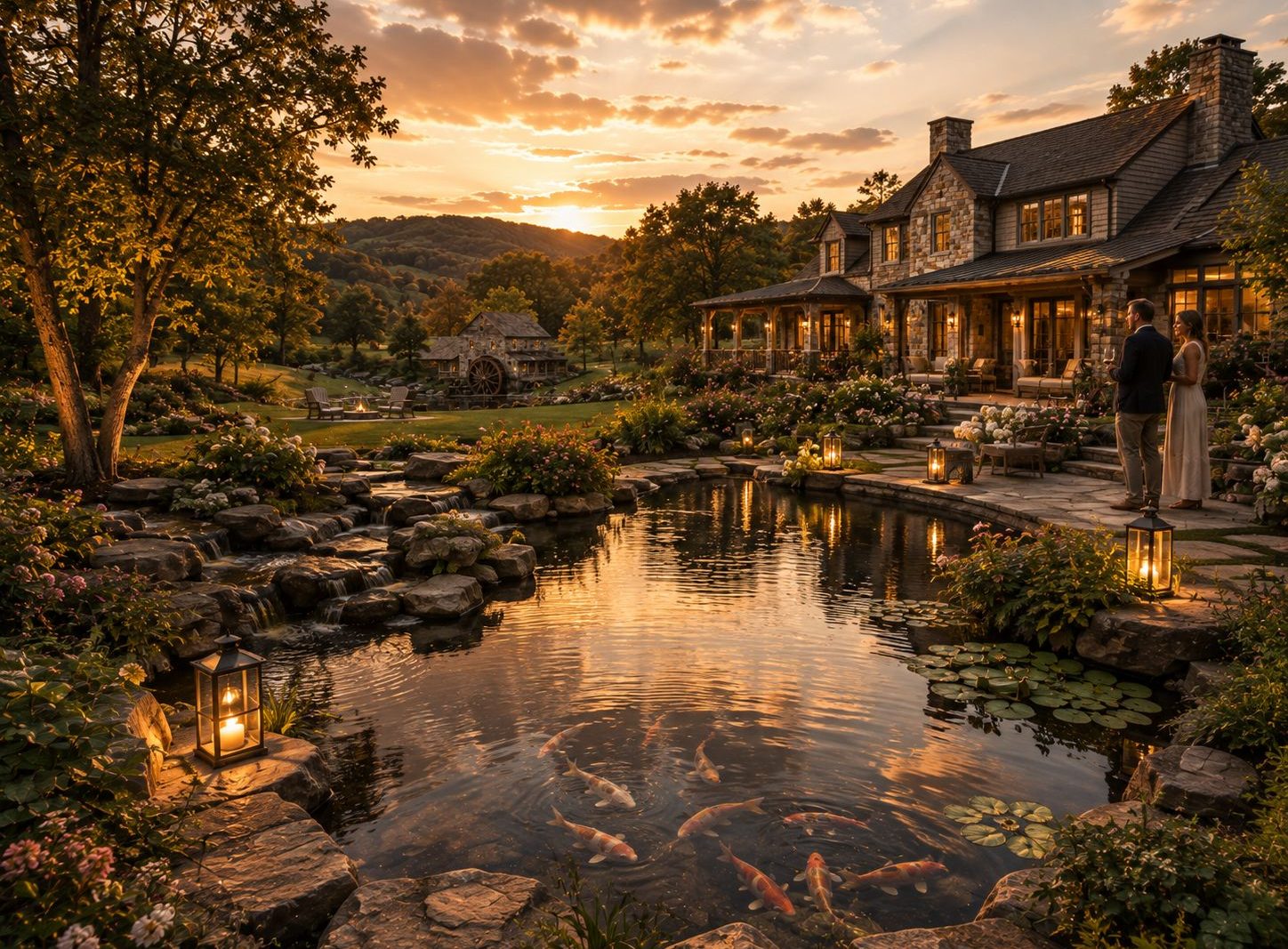
Not every water feature needs drama. Some of the most memorable are quiet. A koi pond introduces something a swimming pool cannot: life. Orange, white and gold fish moving beneath reflected branches create a composition that never quite repeats, while a small rill or gentle fall over stone adds sound to a garden that is becoming quieter as insects diminish and evenings cool.
On a property with a stream and an old mill nearby, the pond also feels naturally connected to the site. It does not imitate the mill pond literally; it simply continues the idea of water through the landscape. The modern pool becomes one expression, the koi pond another, the stream a third. Together they create continuity without repetition.
Outdoor Rooms Should Have Geography
Perhaps the most useful lesson in designing an outdoor space is that every activity needs a home. When dining, cooking, conversation and water constantly overlap, the landscape becomes visually confusing. When each has a clear location, the garden begins to behave like a house. Rooms emerge, movement makes sense, and the host can move naturally through the evening rather than continually rearranging it.
Dinner might begin at the end of the pool facing the valley. Later, everyone drifts toward the fire closer to the house. Someone remains near the outdoor kitchen preparing coffee while another guest wanders toward the pond. The architecture has created a sequence, and that sequence is what makes the experience memorable — not simply beautiful furniture, but beautiful movement.
Fall Is the Season of Layering
By early autumn, outdoor entertaining becomes less about spectacle and more about accumulation: a little more texture, a little more warmth, a little more light. A blanket. A candle. A fire. The pool reflecting the sky. A tree beginning to turn. None of these elements needs to dominate; together they produce atmosphere.
And atmosphere is ultimately what people remember. They may not recall the exact chair, the wine or every flower arrangement. They remember the temperature, the sound of water, the last light across the hills, a fire beginning to crackle as dinner ends, someone laughing beside the pool, a pattern of leaves breaking apart on the water.
That is what good outdoor design can create. Not simply a terrace, but a memory — one shaped by light, fire, water and the particular character of a place as summer begins to loosen its hold.
UNTIL NEXT TIME…
Design is more than aesthetics — it’s a seamless continuum that connects the way we live, work, and gather. Explore new perspectives, timeless craftsmanship, and inspired living with us!
Stay connected to the Seasonal Living Design Continuum Journal. Subscribe today to receive our latest journal entries!