A New England approach to gardens, gathering and the spaces that let the season linger
There is a point in early autumn when the garden becomes more generous precisely because it has stopped pretending to be summer.
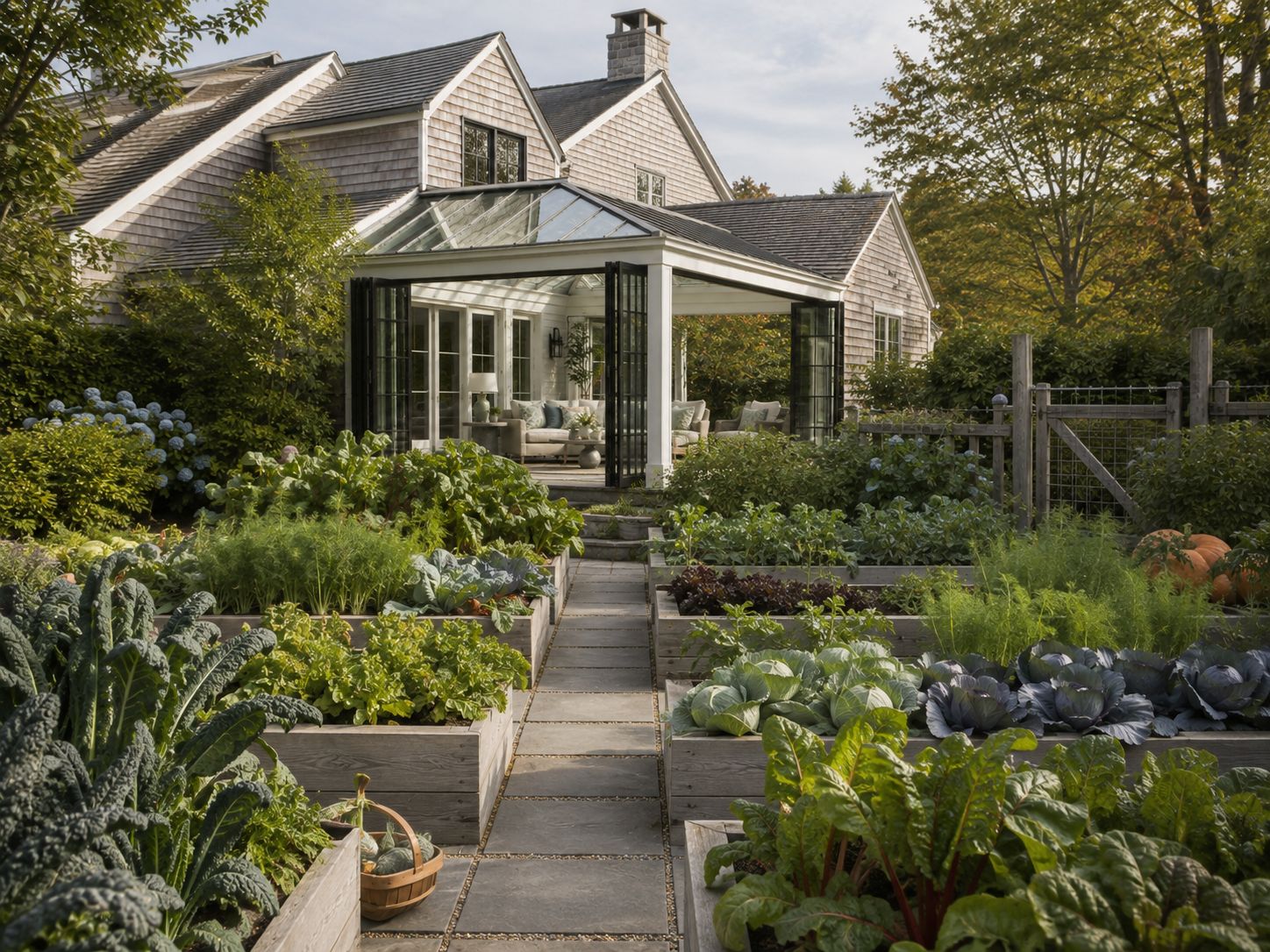
The light comes lower through the trees and stays warmer on the glass. Hydrangeas lose their brightness and become parchment. Chard and cabbage suddenly look more at home in the cooling beds. Figs darken. Tarragon releases its scent at the touch of a hand. A conservatory roof catches the afternoon sun and holds it, briefly, after the garden itself has begun to cool.
In New England, this is one of the most rewarding moments of the year to live between house and landscape. The day may still invite you outside, but evening is already making its argument for sleeves, fire, deeper food and somewhere soft to remain. The useful question is not how to pretend summer has continued. It is how to let autumn arrive without surrendering the garden too quickly.
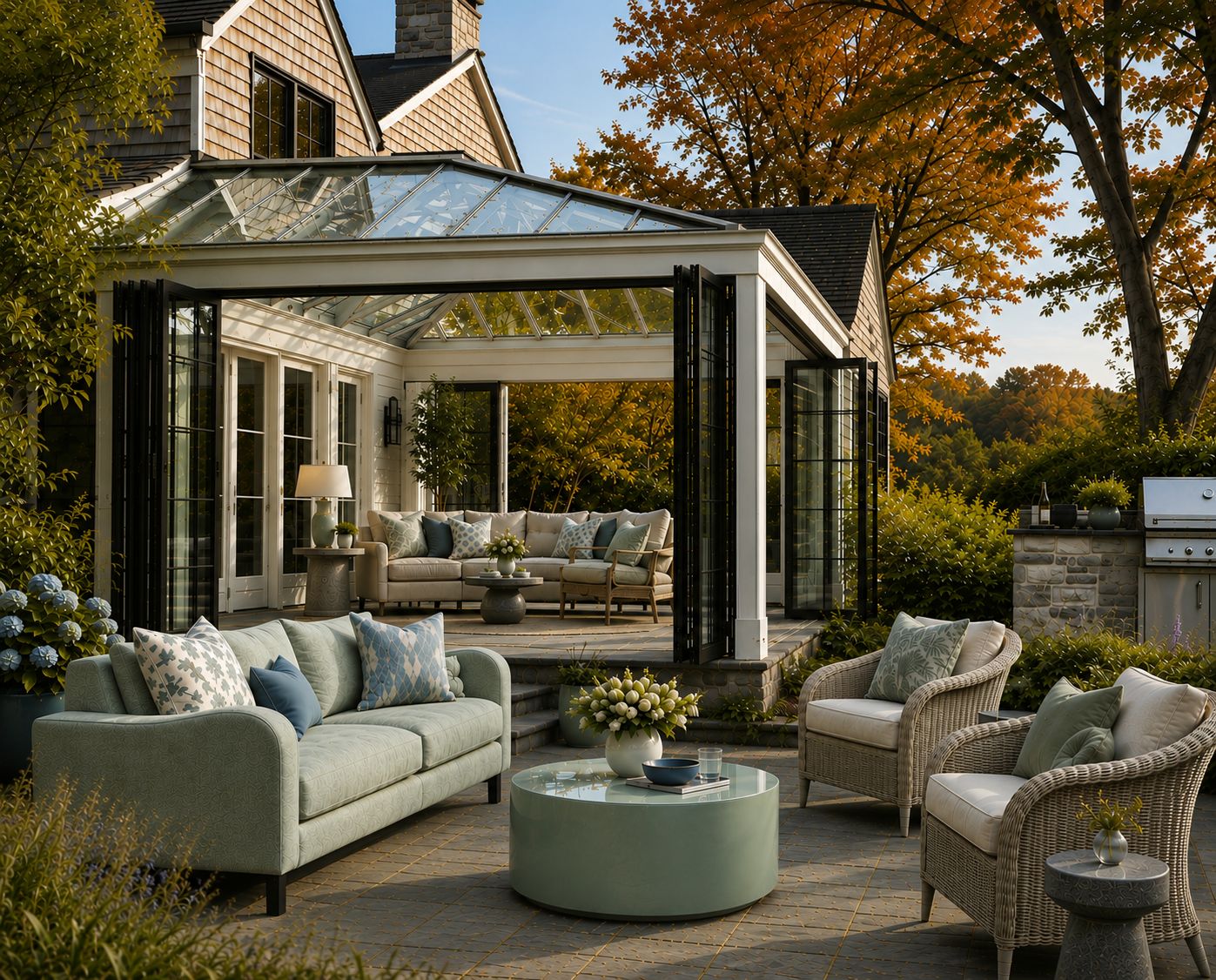
The Most Useful Room May Be the One Between Inside and Out
A conservatory changes the rhythm of a house because it refuses a simple definition. It is neither fully interior nor fully garden. On a bright afternoon it gathers warmth; on a cooler evening it offers shelter without removing the trees, weather and changing light from view.
That ambiguity is valuable. Too much outdoor design is organized as a sequence of hard thresholds: house, door, terrace, lawn, garden. A better approach softens those divisions. Open glazing, adjacent seating and a terrace that feels like a continuation of the room allow people to move according to temperature, conversation and light rather than according to architecture.
This is where Seasonal Living’s Design Continuum becomes more than a product idea. The objective is not to make every chair, table and architectural finish match. It is to create enough continuity in proportion, material and tone that the eye accepts the whole environment as one place.
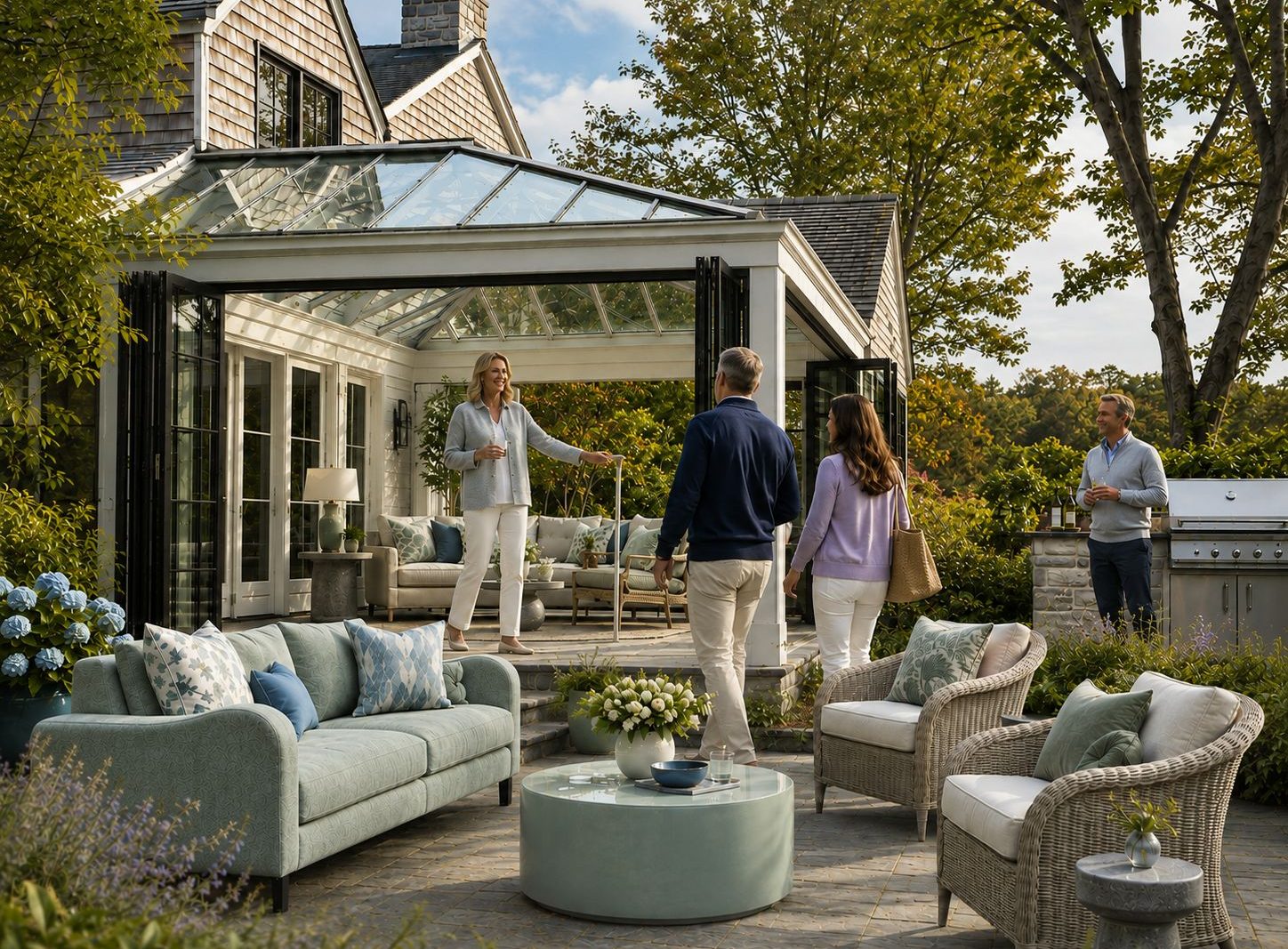
Comfort Is Where the Boundary Really Disappears
Architecture can open a house to the garden, but furniture determines whether people actually choose to stay there. This is why deep seating matters. A sofa outdoors should not feel like a compromise version of the one inside. It should invite the same long conversation, the same instinct to turn sideways, draw up a leg or settle into a corner and forget, for a while, where the room technically ends.
Seasonal Living’s deep-seated upholstery is designed around that blurred threshold. The scale and cushioning have the generous comfort of indoor upholstery while the materials are selected for outdoor life. Homeowners can choose from 20 solution-dyed acrylic fabrics or specify COM, and leg-upgrade options allow the silhouette to move from more relaxed to more tailored depending on the architecture around it. The point of that customization is not choice for its own sake. It allows outdoor upholstery to belong to the house rather than look as though it arrived from an entirely separate category of furniture.
The tailored, easily removable slipcovers may be the most useful detail of all. Outdoor living is supposed to involve living: shoes come off, feet go up, dogs arrive wet from the grass, children carry food, pollen settles and somebody eventually brushes a glass with an elbow. A cover that can be removed for cleaning changes the psychology of the furniture. A scuff is no longer a crisis. Dust, pollen and pet dander can be managed more readily through regular cleaning, which can be especially useful in households sensitive to environmental allergens, without making a medical claim that the furniture itself prevents allergy symptoms.
There is also the question of presentation. Upholstery can be refreshed after a season of heavy use rather than slowly acquiring the tired look people have come to accept outdoors. Cleanliness and elegance stop being opposing ideas. The sofa can look tailored when guests arrive and still be the place where the family put their feet up the night before. That, more than any technical distinction between indoor and outdoor, is what makes the boundary disappear.
A Productive Garden Changes the Meaning of Entertaining
A beautiful garden can provide a view. A productive one can provide a reason to walk into it.
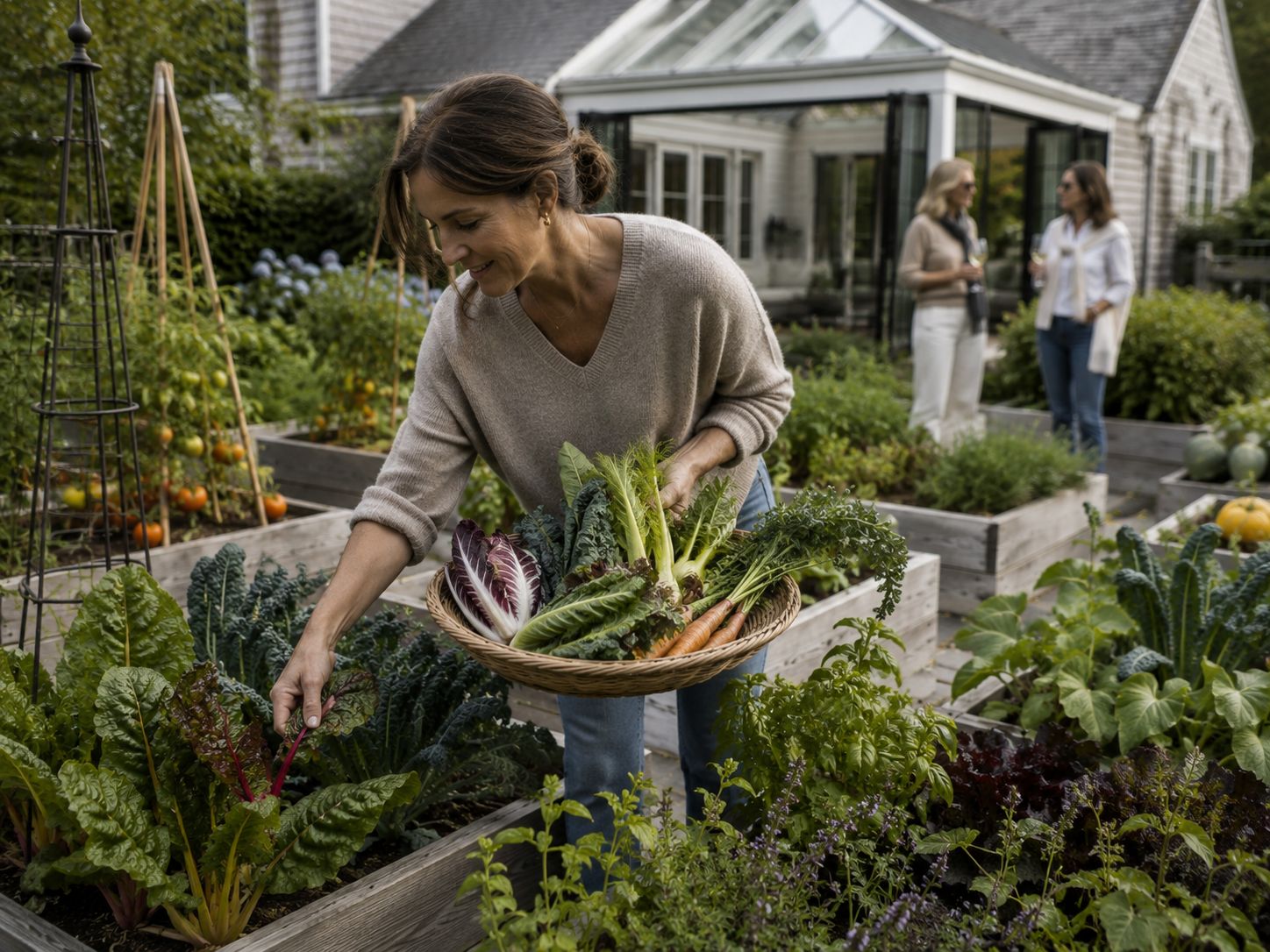
That distinction matters when people gather. A guest who follows the host into raised beds to cut tarragon or collect a basket of greens has already become part of the meal. The garden stops functioning as scenery and becomes part of the hospitality.
This does not require a romantic fantasy of self-sufficiency. Few households need to grow everything they eat, and there is no virtue in making dinner unnecessarily difficult. The more useful idea is proximity: perhaps the herbs, the figs, a basket of leaves, some late carrots or the flowers for the table come from within sight of where everyone will eventually sit.
The numbers make clear that edible gardening is not a passing pandemic souvenir. The National Gardening Association’s 2026 research reports that although the total U.S. gardening audience contracted in 2025, the gardeners who remained became more committed: spending on vegetables rose 24 percent per participant to a record $108, while spending on herbs rose 31 percent. In 2024, 51.8 million U.S. households were already growing vegetables. The same research identifies an intriguing shift toward smaller-space cultivation: renters now out-purchase homeowners in both vegetable and herb seed.
That changes the design conversation. A productive garden is no longer best understood as a hidden utility zone beyond the ornamental landscape. Raised beds, herbs, fruit and edible planting can be part of the architecture of outdoor living itself — close enough to the terrace to be used, beautiful enough to be seen, and relevant to a generation increasingly interested in knowing where food comes from.
The National Gardening Association also reports that among households intending to garden more in 2026, roughly two in three cite inflation as an important reason. Food gardening therefore sits at an unusual intersection of pleasure, resilience and household economics: people may begin with tomatoes or herbs because they taste better, but they are also responding to a wider desire for value, control and self-reliance.
A row of chard can be beautiful. So can herbs allowed to flower. Fruit, vegetables and native planting can coexist with the more composed elements of a residential garden, creating a landscape that looks inhabited rather than merely maintained.
Then Add Hens
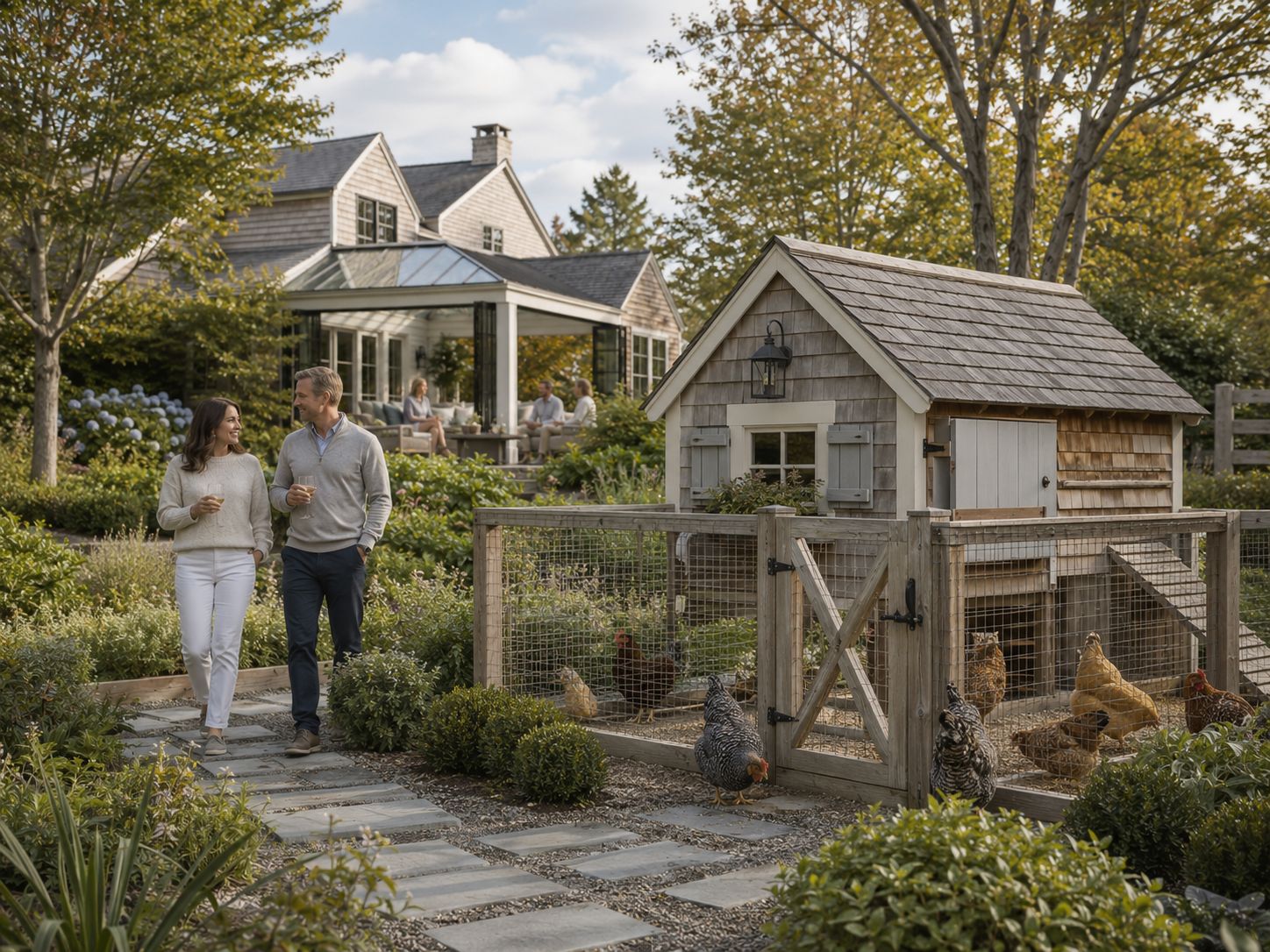
The small chicken house at the edge of the garden is another example of usefulness becoming part of the landscape.
Backyard hens have moved well beyond the image of a rural farmyard. Cornell Cooperative Extension notes that raising chickens for eggs has become more popular in recent years, while reporting in 2025 by the Associated Press found another surge of interest as high egg prices pushed households to consider their own flocks. Cornell educators described that interest as sustained since the pandemic rather than a short-lived reaction.
The attraction is understandable, but the trend becomes more interesting when it is viewed as part of the same movement driving vegetable gardens: people want a closer relationship with food production. Cornell research into pandemic-era ‘wild and backyard foods’ found that 40 to 46 percent of participants increased the time they devoted to activities including gardening and poultry rearing, and that home-produced eggs were being eaten in meaningful quantities rather than kept as a novelty.
That does not make a chicken coop a decorative accessory. Good husbandry requires legal awareness, predator protection, sanitation, feed, clean water and careful biosecurity — particularly while highly pathogenic avian influenza remains a concern. The most convincing residential coops therefore combine good design with serious animal care.
They should never be treated as decorative accessories. Keeping poultry requires proper shelter, predator protection, clean water, good feed and responsible health practices. But when those needs are met, a thoughtfully designed coop can sit comfortably within a sophisticated residential landscape rather than being hidden behind it.
And Leave Room for the Bees
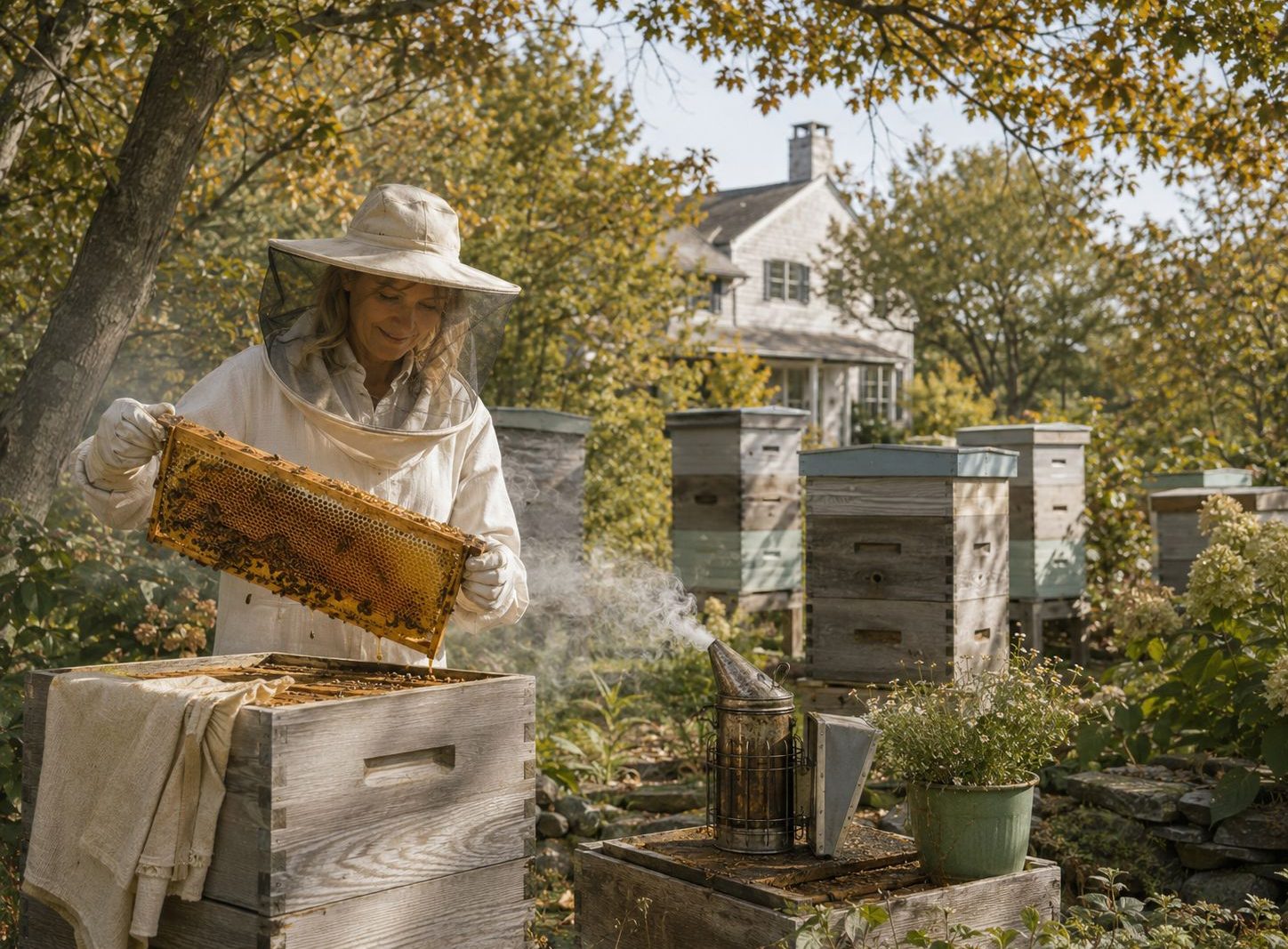
Bees make the same argument in a quieter way. Their presence connects flowers, fruit and food into one visible system.
The renewed interest in bees is part of a larger shift toward pollinator-conscious gardening. University of Minnesota Extension emphasizes that pollinators are fundamental to food production and healthy plant communities; its 2026 guidance notes that most fruit crops rely on or benefit from insect pollination, primarily bees. At the same time, concern over declines in bee and other pollinator populations has pushed gardeners and growers toward planting that provides forage across early, mid- and late-season bloom periods rather than treating pollinator habitat as a single flower bed.
There is even evidence that this ecological awareness is becoming a consumer value. University of Minnesota research released in 2026 found participants willing to pay meaningful premiums for produce explicitly identified as pollinator-friendly. That does not mean every household needs beehives, but it does suggest that the relationship between garden design, biodiversity and food is becoming more visible to the people who use these spaces.
For a residential landscape, the practical lesson is attractive in its simplicity: allow herbs to flower, include native and pollinator-friendly plants, stagger bloom through the season, reduce unnecessary chemical inputs and give useful plants the same aesthetic consideration as ornamental ones. The garden becomes more alive because it is doing more.
The honey is almost incidental, although it becomes a particularly persuasive ingredient when a piece of comb appears later beside warm figs and burrata. The more interesting luxury is understanding where something on the table came from.
A Garden – The Center of the Circle of Life?
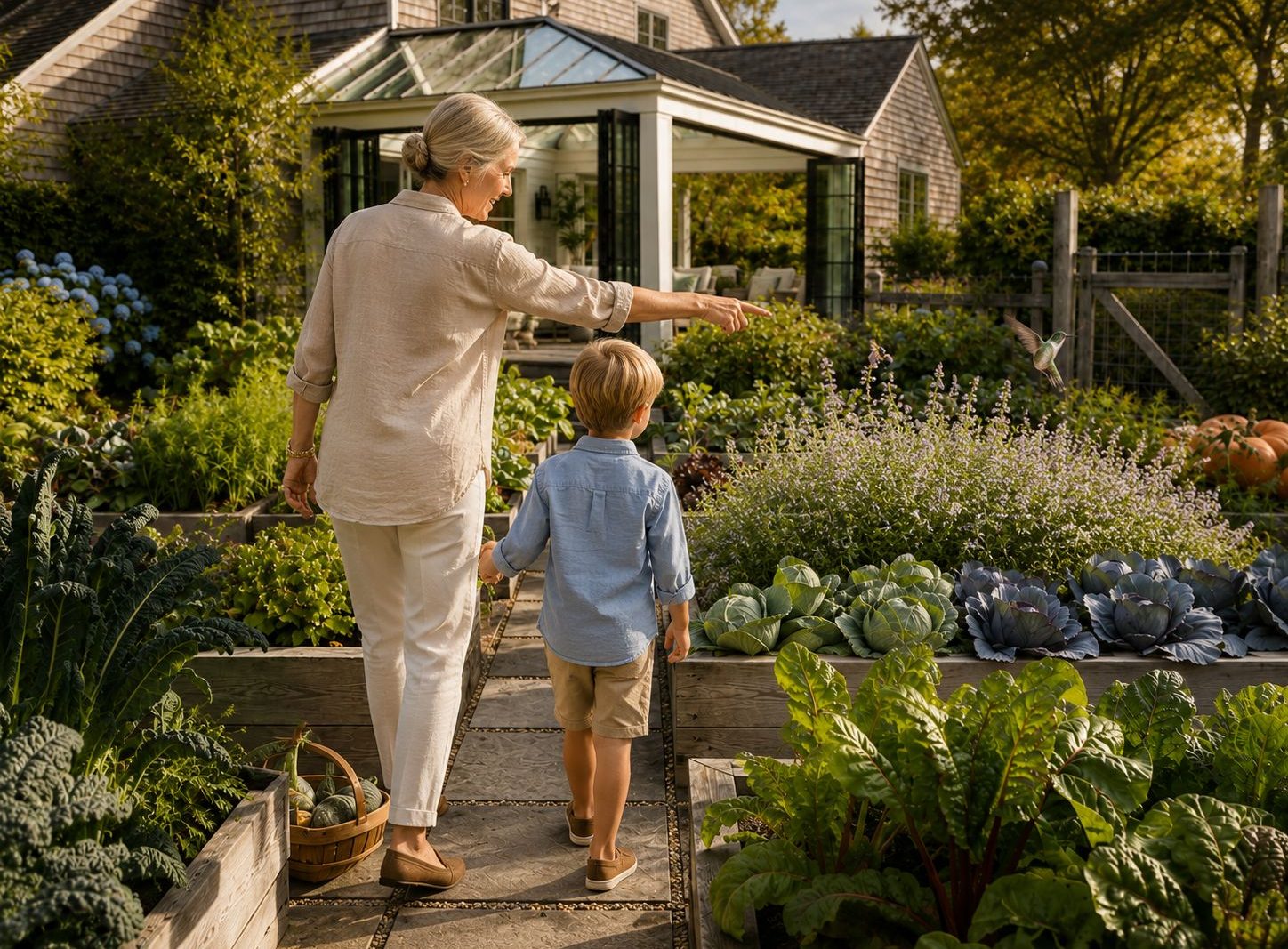
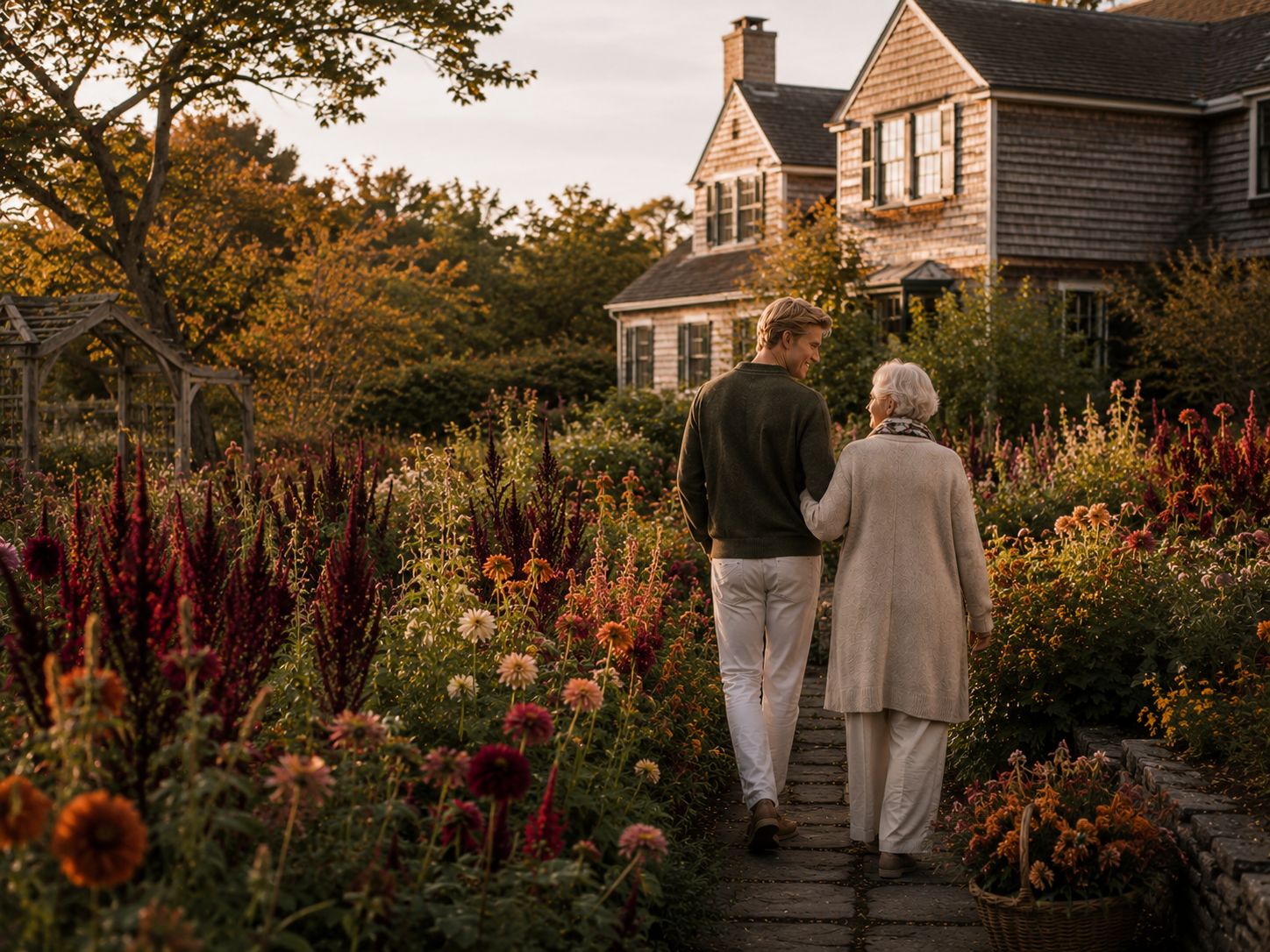
The beds may be different, but the relationship is recognizable. What began with a child’s hand pressed into soil can, many decades later, become an adult hand guiding an aging parent along a path. The garden has changed roles without ever leaving the family. The Circle of Life is still connected.
Social contact is part of that return. Gardening together gives an older parent or grandparent something to discuss, notice, choose and contribute. It creates conversation that is not entirely about health, appointments or what has been forgotten. For someone living with cognitive decline, that distinction can be precious. The garden offers subjects in the present tense: this leaf, this scent, this bird, this tomato, this patch of sun.
And perhaps the most moving part of the circle is when the child who once followed a parent or grandparent through the beds becomes the adult who leads that older person back outside. The garden may have gone. The climate may be different. The house may have changed and everyone in the family may have changed a little too. But a pot of herbs on a terrace, a raised bed at a senior community, a visit to a public garden or a few flowers to deadhead can restore a familiar rhythm. The younger person now carries the basket, steadies the path or remembers what the older person once taught.
That matters especially later in life. Research on horticultural activity in older adults has associated gardening and horticultural therapy with benefits that include physical activity, engagement, mood, self-efficacy, quality of life and, in some studies involving people living with dementia, improvements in participation and cognitive or behavioral measures. The evidence is stronger for gardening and horticultural activity than for beekeeping or keeping hens specifically, so those distinctions should remain clear. But the broader principle is compelling: a garden can provide purpose, routine, sensory stimulation and an invitation to take part.
As adulthood arrives, the garden changes again. It becomes exercise without announcing itself as exercise: lifting, reaching, walking, kneeling, carrying, pruning. It can become a place to recover from work, to notice weather instead of notifications, or to maintain the quiet competence that comes from knowing how to grow, mend, divide, propagate and harvest. For families, it can remain one of the few places where contribution is naturally shared across ages and abilities.
Flower gardens deserve the same place in this circle. A child who grows zinnias, cosmos or nasturtiums begins to understand beauty as something cultivated rather than consumed. Flowers can be cut for the table, carried to a neighbor, given to a teacher or left standing for bees and butterflies. They introduce color, scent, seasonality and generosity, while also teaching that a garden can feed more than people. In a landscape with hives nearby, the connection becomes especially clear: the flowers sustain the pollinators; the pollinators support fruit and seed; the honey eventually returns to the table. The circle becomes visible.
There is also the simple pleasure of doing something beside a parent or grandparent that does not require a screen. Hands become dirty. A worm is discovered. A tomato is eaten before it ever reaches the kitchen. Questions arise naturally because the garden keeps presenting things that have not happened before. Technology need not be excluded; in its best role here, it becomes a tool rather than the environment itself – used to identify a caterpillar, look up when to sow a seed or learn why a flower attracts a particular pollinator, and then put away again so the real lesson can continue outdoors.
The lesson is larger than gardening. Children who work beside a parent or grandparent are also learning how to share time with another person. There is no requirement to perform, entertain or swipe to the next thing. Conversation can wander because the hands are occupied. Stories are told. Questions are asked. A grandparent can explain why beans are tied one way, why a rose is cut above a bud, or why the bees suddenly seem busier before rain. Those exchanges build the ordinary social skills on which close relationships depend: listening, taking turns, noticing another person’s knowledge and discovering that companionship does not require constant digital stimulation.
For a young child, a vegetable or flower patch can become a first territory of responsibility. A few radishes, strawberries, sunflowers or sweet peas are enough. Seeds disappear into dark soil and, days later, something green insists on returning. A child learns that food does not begin in a package, that flowers are not manufactured objects, and that living things respond to attention, weather, patience and neglect. There is counting in the seed spacing, biology in the roots and insects, weather in the sky, taste in the first tomato and consequence in forgetting to water.
A garden does something unusual to time. It lets several generations stand in the same place and experience the same small astonishments from different ends of life.
Preparation Should Be Part of the Party
There is a persistent idea that accomplished entertaining requires the host to conceal the work. I have never understood it.
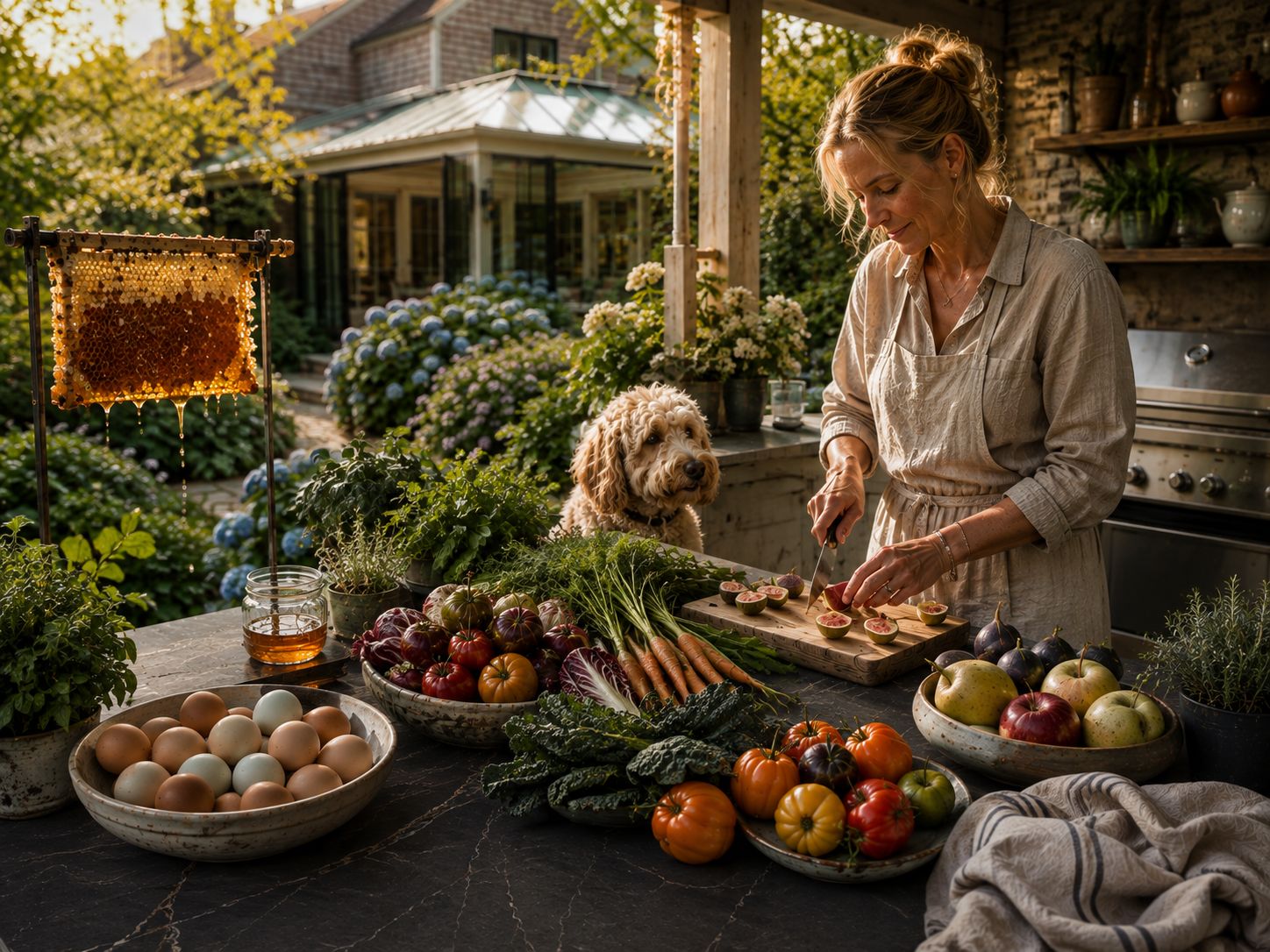
Some of the best moments occur before anybody is officially seated: vegetables spread across a counter, eggs in a bowl, herbs waiting to be chopped, a jar of honey catching the light, a dog convinced that all of this activity must somehow concern him.
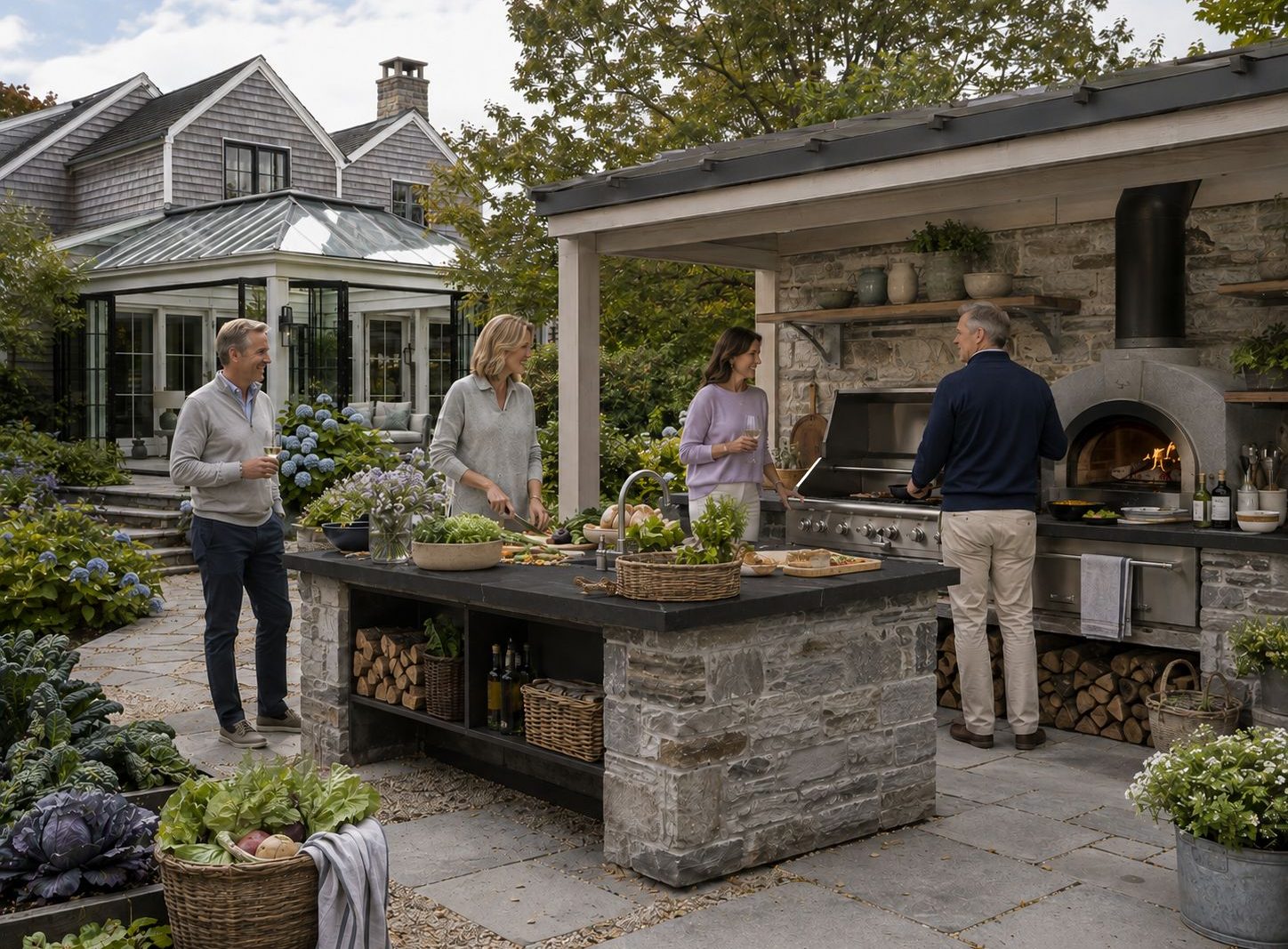
An outdoor kitchen makes that preparation sociable. It allows several people to contribute without crowding an indoor room, and it keeps the smells, conversation and movement connected to the garden. The most successful versions are not showrooms for appliances. They have generous work surfaces, water, storage, shade and enough room for people to stand together.
The First Course Should Explain the Place
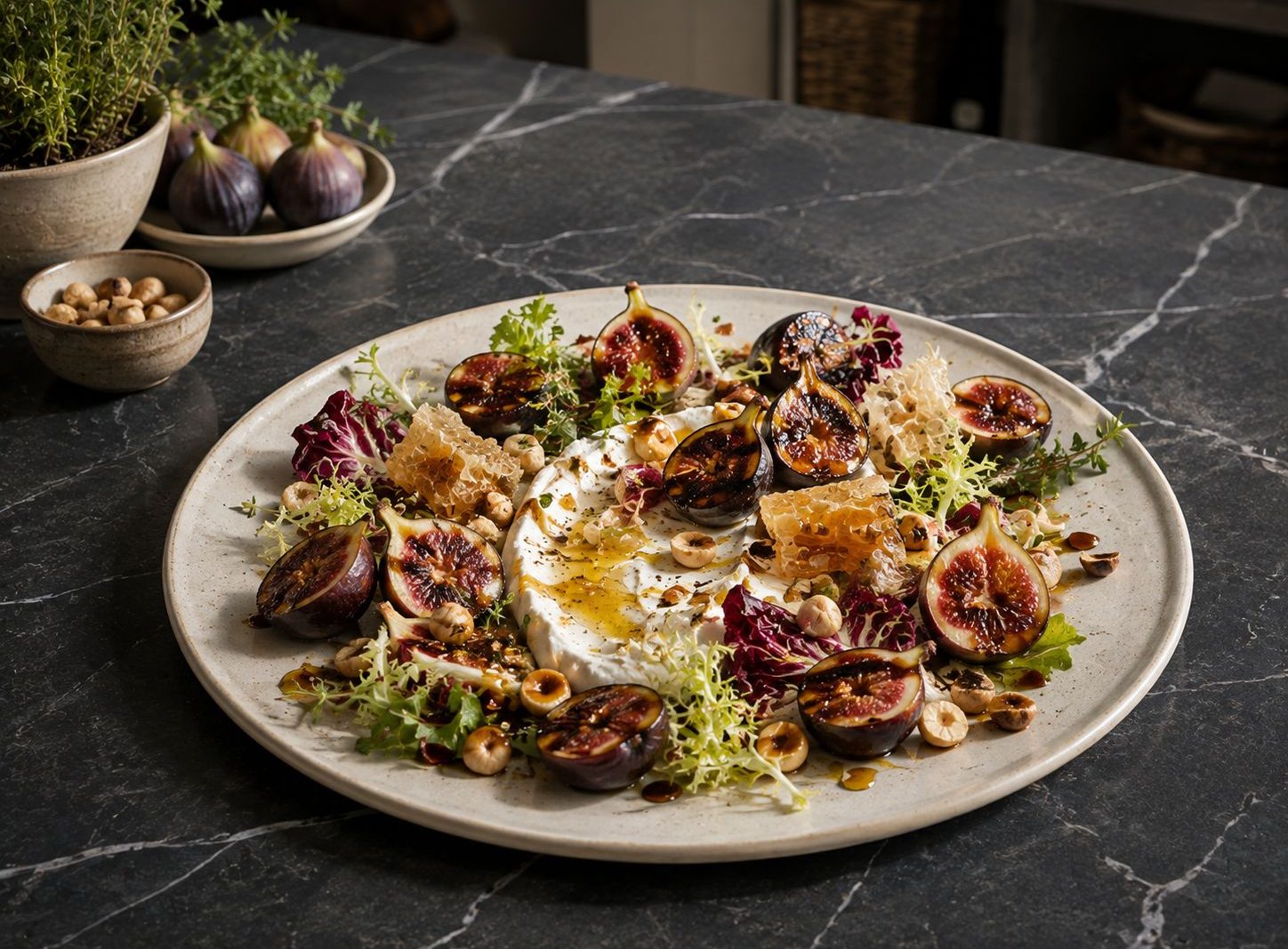
Warm figs with burrata, hazelnuts and honeycomb do exactly that.
The figs are the only part that needs the oven. A short roast softens them and intensifies their sweetness without collapsing the fruit. They are then arranged with cool burrata, toasted hazelnuts, bitter leaves, thyme, honeycomb and a restrained honey-balsamic dressing.
What makes the dish appropriate here is not simply that it tastes of autumn. It carries the garden into the meal. Fruit, herbs and honey appear in a form that still feels close to their source, and the platter is generous enough to place in the middle of a group rather than portion individually.
Do Not Decorate What the Season Has Already Decorated
By late afternoon, the garden is supplying almost everything the table needs visually.
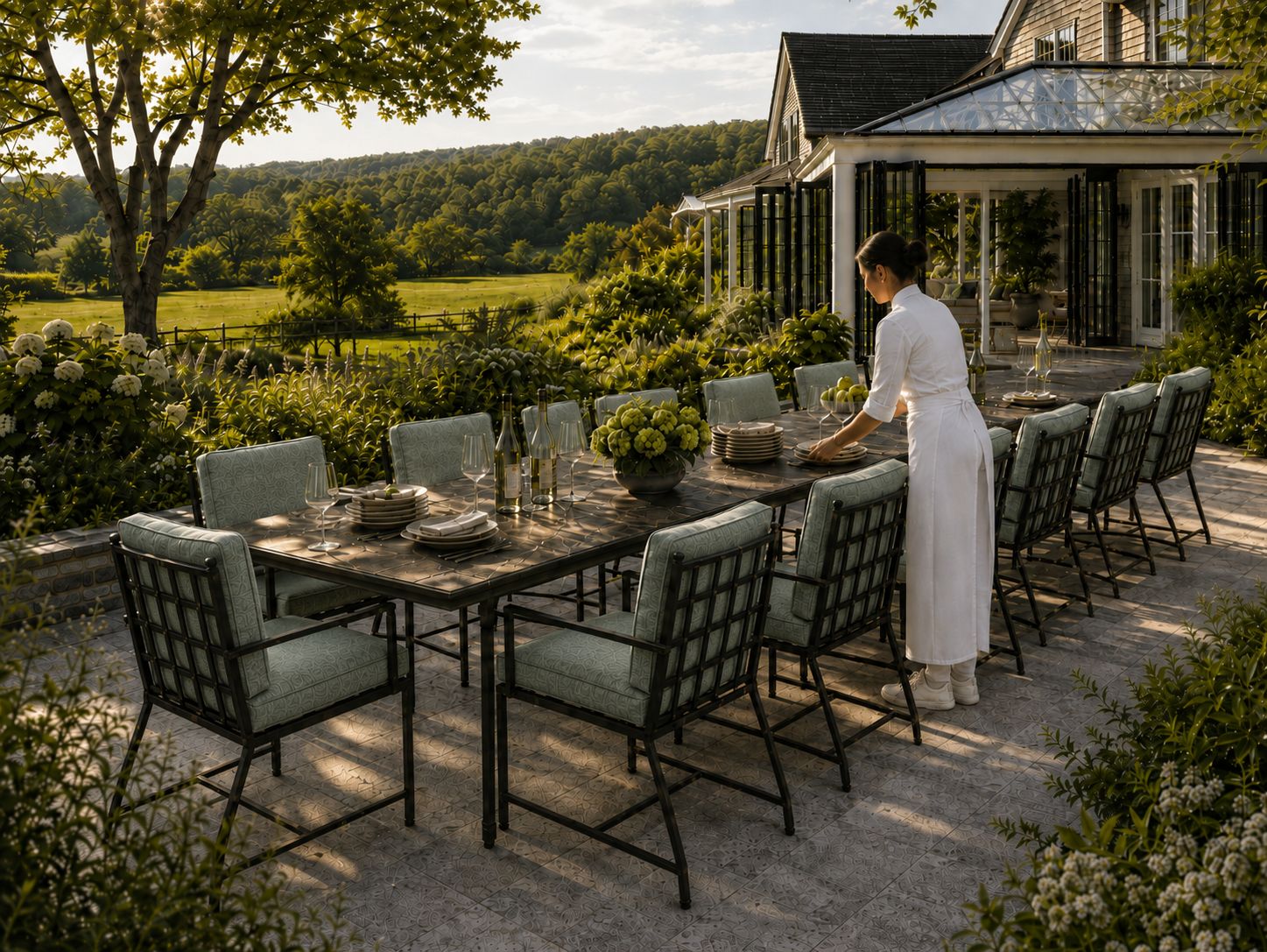
This is where restraint becomes more sophisticated than seasonal styling. There is no need to announce autumn with a collection of themed objects. The pale blue-green upholstery, dark metal frames, clear glass, linen, stone and soft green flowers give the landscape room to provide the color.
The table itself should feel substantial enough to hold a proper meal but visually open enough that the view continues through it. Dining chairs need comfort because autumn dinners tend to lengthen as the light drops. Once guests settle, the success of the furniture is measured less by how noticeable it is than by how little reason anyone has to leave it.
Cook Something That Improves While You Are Talking
The main course follows the same logic as the architecture: it should reduce friction.
Braised chicken with sherry and tarragon is built for a gathering because the work happens before the table demands attention. Bone-in chicken thighs are browned, then braised with shallots, garlic, dry sherry, stock, Dijon and tarragon. The covered portion of the cooking tenderizes the meat; the uncovered finish deepens the pan and brings the total cooking time to about an hour and five minutes. Crème fraîche and lemon are added at the end to make the sauce rounder without making it heavy.
The resulting dish is not fragile. It can rest for a few minutes. It can be carried to the table in the pan. It welcomes carrots, greens, buttered rice or polenta beside it. This is the kind of food that lets the host pour a glass of wine and remain in the conversation rather than watching a timer from the kitchen.

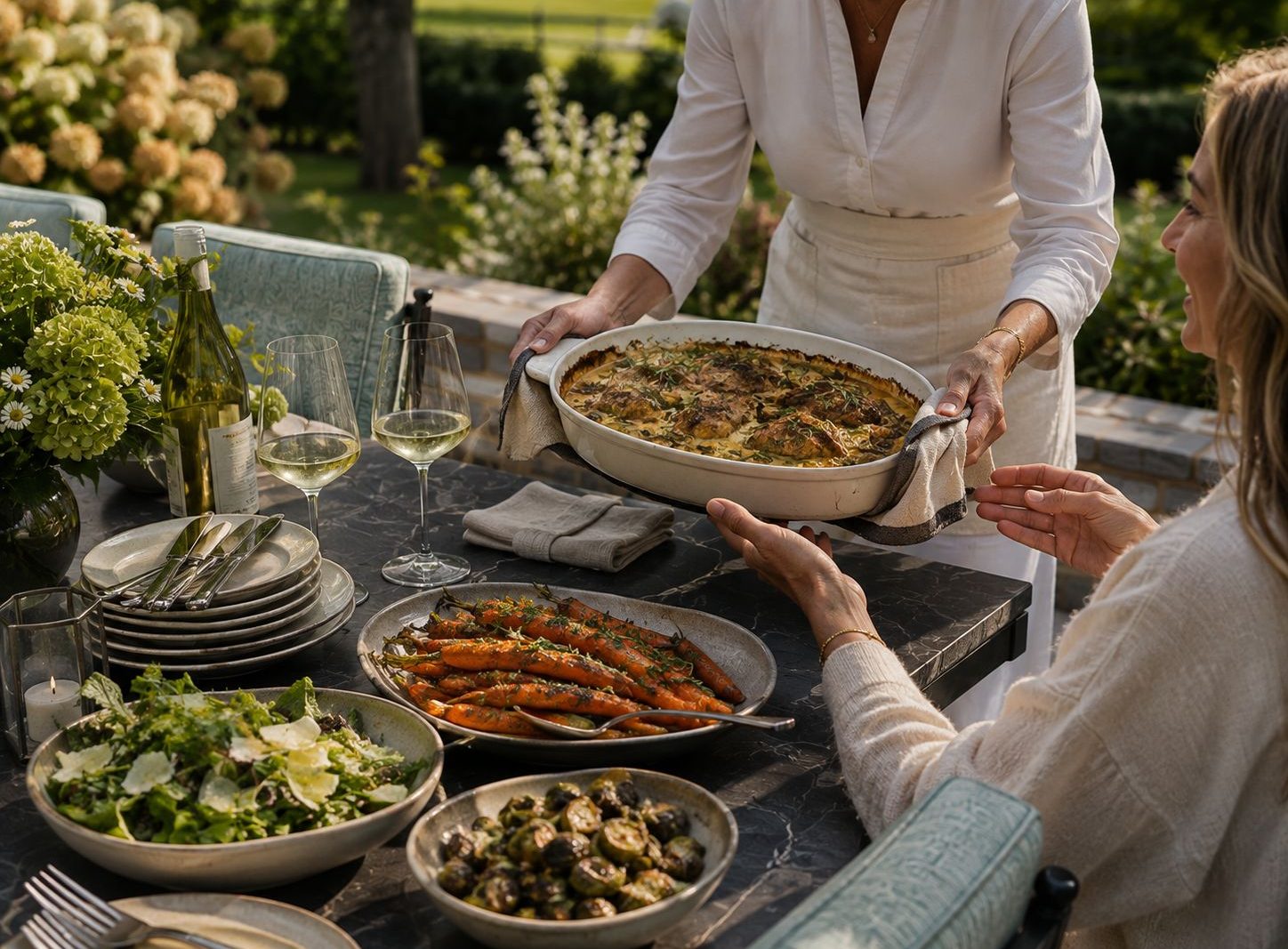
The Point of the Design Is the Moment When Nobody Notices It
When everyone finally sits down, the various ideas in the house become one experience.
The conservatory has kept the interior connected to the evening. The garden has supplied ingredients and conversation. The outdoor kitchen has kept preparation social. The table has given the group somewhere comfortable to settle without turning dinner into ceremony. Furniture, architecture, landscape and food have each done part of the work.
This is the larger value of indoor-outdoor design. It is not the possession of an outdoor room. It is the removal of small obstacles between the life of the house and the life around it.
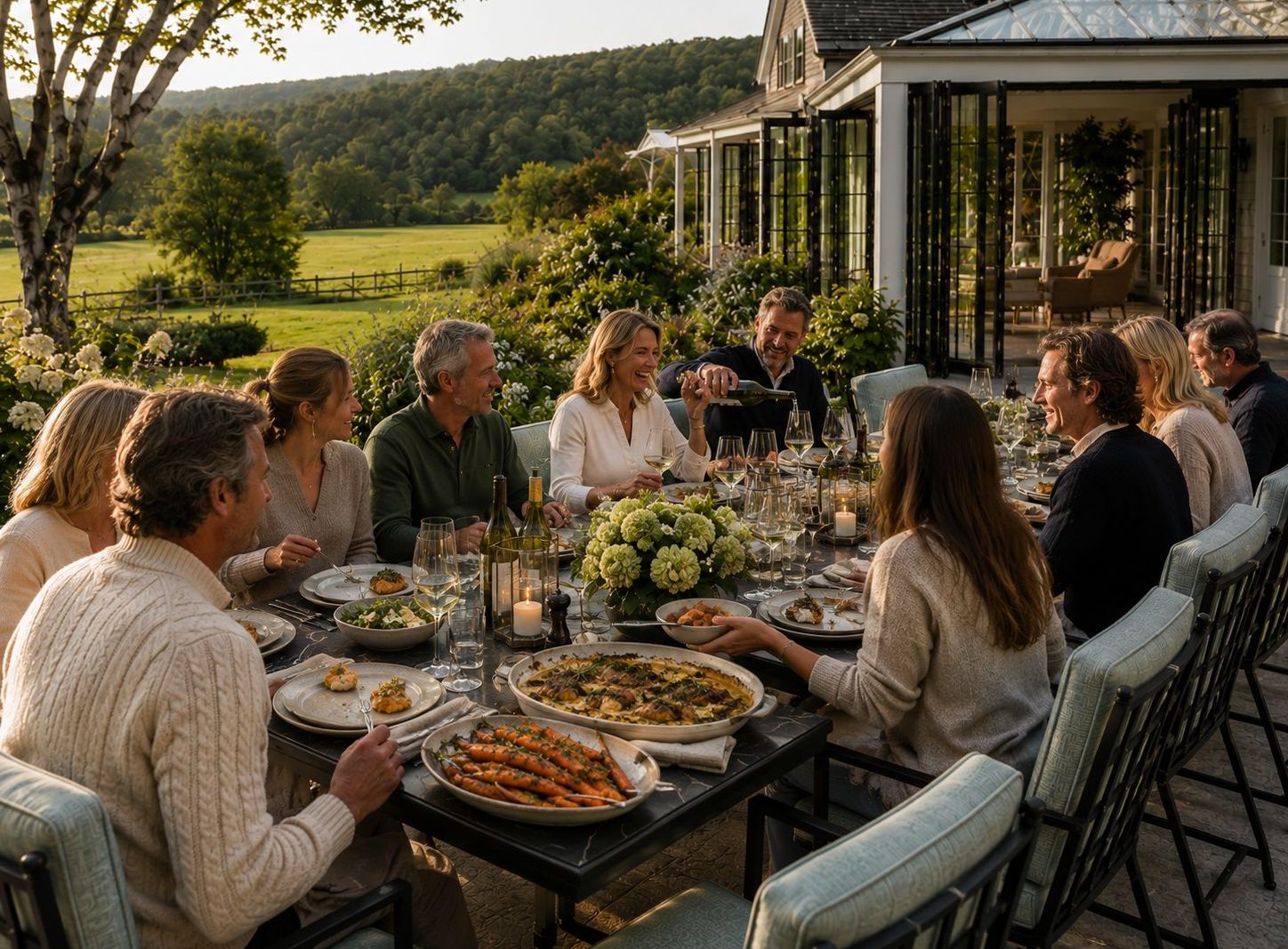
Keep Autumn Outside a Little Longer
Soon enough, the evening will become genuinely cold. The beds will empty. The conservatory glass will hold a different quality of light. The hens will settle earlier and the bees will become less visible.
But extending the outdoor season was never about denying that change.
It is about noticing that autumn offers a different way to live outside: closer to the house, more attentive to warmth, more interested in food, more appreciative of shelter and perhaps more willing to sit still.
Summer asks almost nothing of us outdoors. Autumn asks that we notice: the shorter light, the cooling stone, the last fig, the chair we pull closer to the house, the older hand still reaching for a tomato on the vine.
Perhaps that is why the better autumn gatherings feel less arranged than understood. The house has not conquered the season. It has simply learned how to live with it.
SEASONAL LIVING RECIPES
Both recipes from this gathering are available as Seasonal Living recipe cards.
Warm Figs with Burrata, Hazelnuts & Honeycomb
Serves 8 · Makes 1 platter · Prep 20 min · Cook 10 min
View & Download the Recipe Card (PDF)
Braised Chicken with Sherry & Tarragon
Serves 8 · Makes 8 portions · Prep 25 min · Cook 1 hr 5 min
View & Download the Recipe Card (PDF)
UNTIL NEXT TIME…
Design is more than aesthetics — it’s a seamless continuum that connects the way we live, work, and gather. Explore new perspectives, timeless craftsmanship, and inspired living with us!
Stay connected to the Seasonal Living Design Continuum Journal. Subscribe today to receive our latest journal entries!