In the Tennessee Mountains, Autumn Draws Us Closer — to Fire, Shelter, Landscape and One Another
There are places where autumn arrives politely, changing a hedge here and a maple there. In the mountains of eastern Tennessee, it can feel more like a curtain rising. By October, entire ridges ignite at once: scarlet maple, yellow-gold hickory, copper oak and the deep green punctuation of pine. In the first light, mist lies low in the valleys, slipping between folds of mountain before the sun begins to lift it. Farther away, ridge after ridge softens into blue-grey, until the last one seems less like land than atmosphere.
The scale is almost disorienting. You can stand above a valley and watch sunlight travel across it, touching one hillside while another remains cool and shadowed. Then, somewhere far below, a roof catches the light. A chimney appears through the trees. The house is suddenly tiny, and that is precisely what makes it feel right.
The spectacle is made more beautiful by what we know about it: none of this color intends to stay. Perhaps that is why autumn sharpens attention. We notice the hour of the light, the smell of woodsmoke, the temperature of stone beneath a hand. Beautiful things become more vivid when we understand that they are passing.
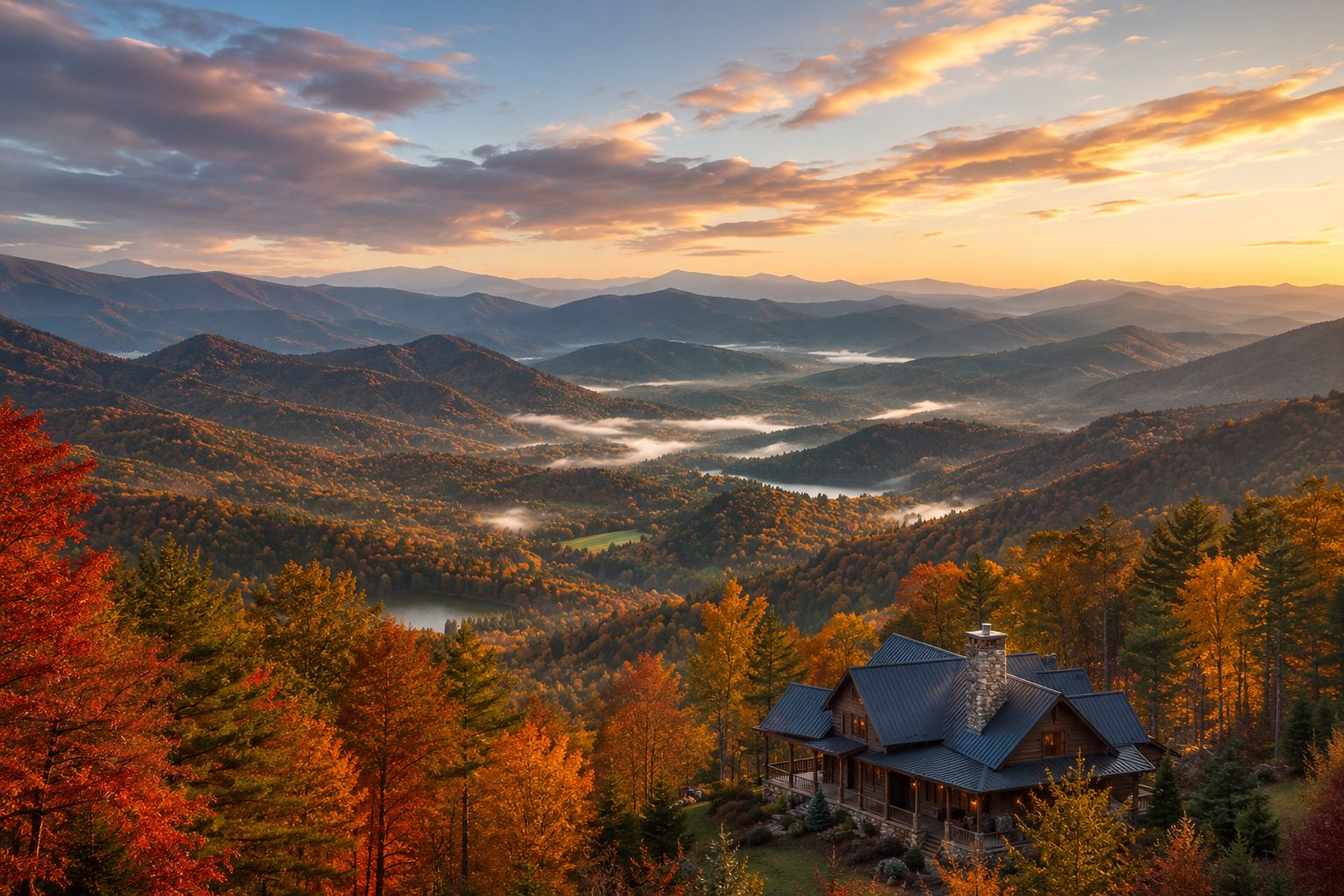
From this distance, timber, stone and dark metal roof are reduced to a few deliberate lines among thousands of acres of forest. The mountains remind us that architecture need not dominate a landscape to belong within it. The most persuasive mountain homes seem to have found their place rather than imposed themselves upon it.
Autumn makes that relationship particularly vivid. The house becomes shelter. The porch becomes threshold. The hearth begins to matter again. After months of outdoor living defined by expansiveness, the season quietly rewrites the rules. Summer asks us to spread out. Autumn draws us in.
Walk Into the Season
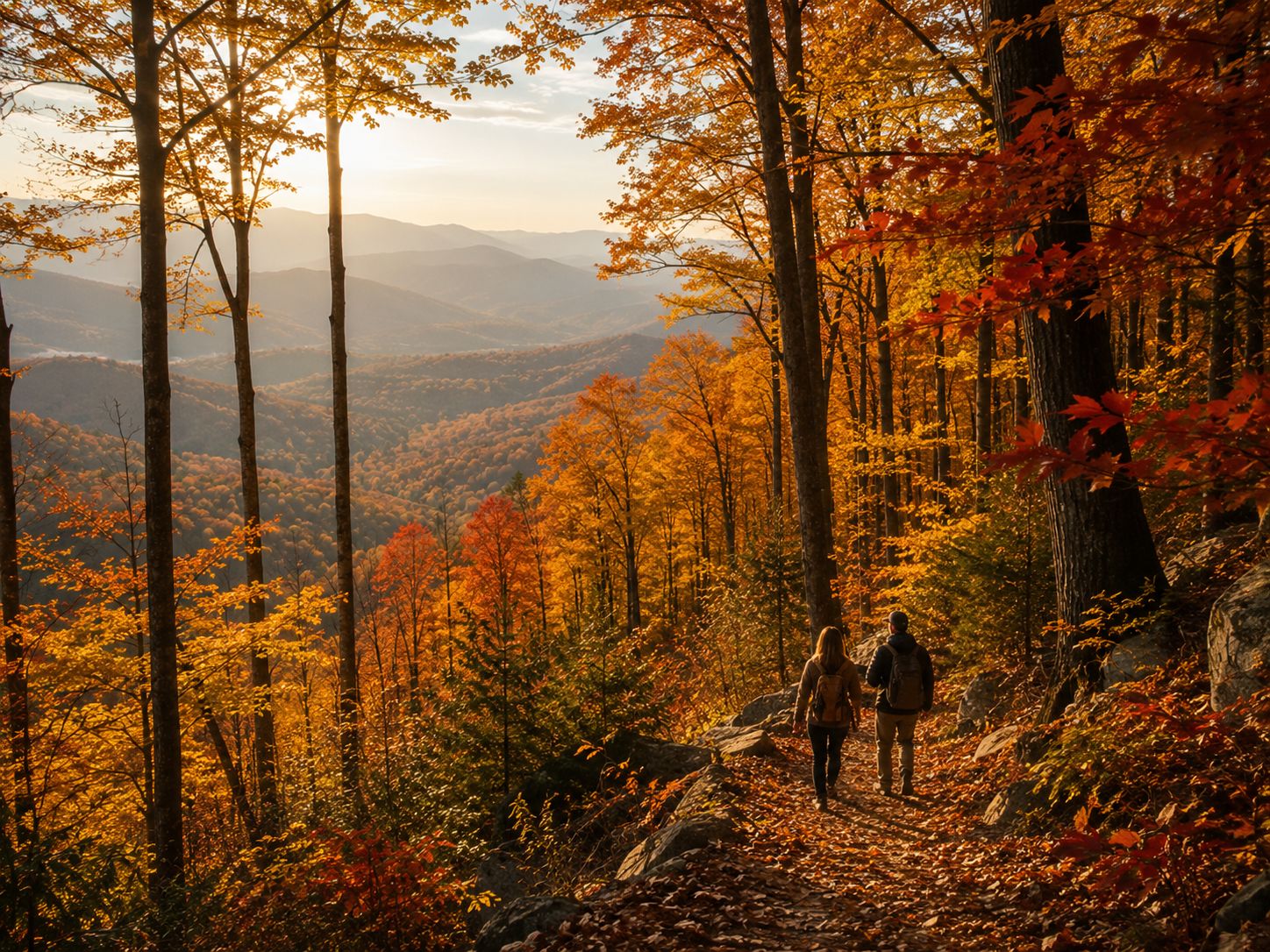
There may be no better way to understand a Tennessee autumn than to leave the house and enter it on foot. On the trail, the color that looked painterly from a distance becomes physical. Leaves gather ankle-deep around roots and rocks. They catch in ferns, cling darkly to damp ground and release that unmistakable dry crackle beneath a boot.
The air has its own inventory: wet bark, cold stone, leaf mould and the faint mineral smell that rises after rain. A breeze high in the canopy arrives first as sound. Somewhere below, water moves over rock. Then the trees open unexpectedly and the whole valley appears, enormous and layered, as though the mountains have pulled back a curtain.
Walking changes the scale of the day. What seemed urgent over breakfast rarely survives the first mile. The season is spectacular, certainly, but it is also corrective. It turns attention outward.

At ground level, grandeur becomes intimate. A polished chestnut splits from its burr. Wet maple leaves shine against black soil. Mud gathers at the edge of a boot. The wool blanket tucked into a basket begins to smell faintly of forest.
These details matter because memory rarely keeps only the vista. It keeps the crunch beneath a foot, cold fingertips around a cup and smoke caught in a sweater. Tennessee in autumn is not simply something to look at. It is something that settles onto you.
Coming Back to Fire
There is a particular hour in the mountains when the terrace changes character. The sun may still begilding the upper branches, but the shadow of the house has crossed the stone and the temperature has dropped almost without announcement. Someone brings another armful of wood. A jacket appears. A chair is turned a few degrees toward the hearth.
Human beings have arranged themselves around fire for longer than we have arranged ourselves around almost anything else. Modern outdoor rooms may be beautifully engineered, but introduce flame and the instinct remains unchanged: we face it, move toward it and stay.
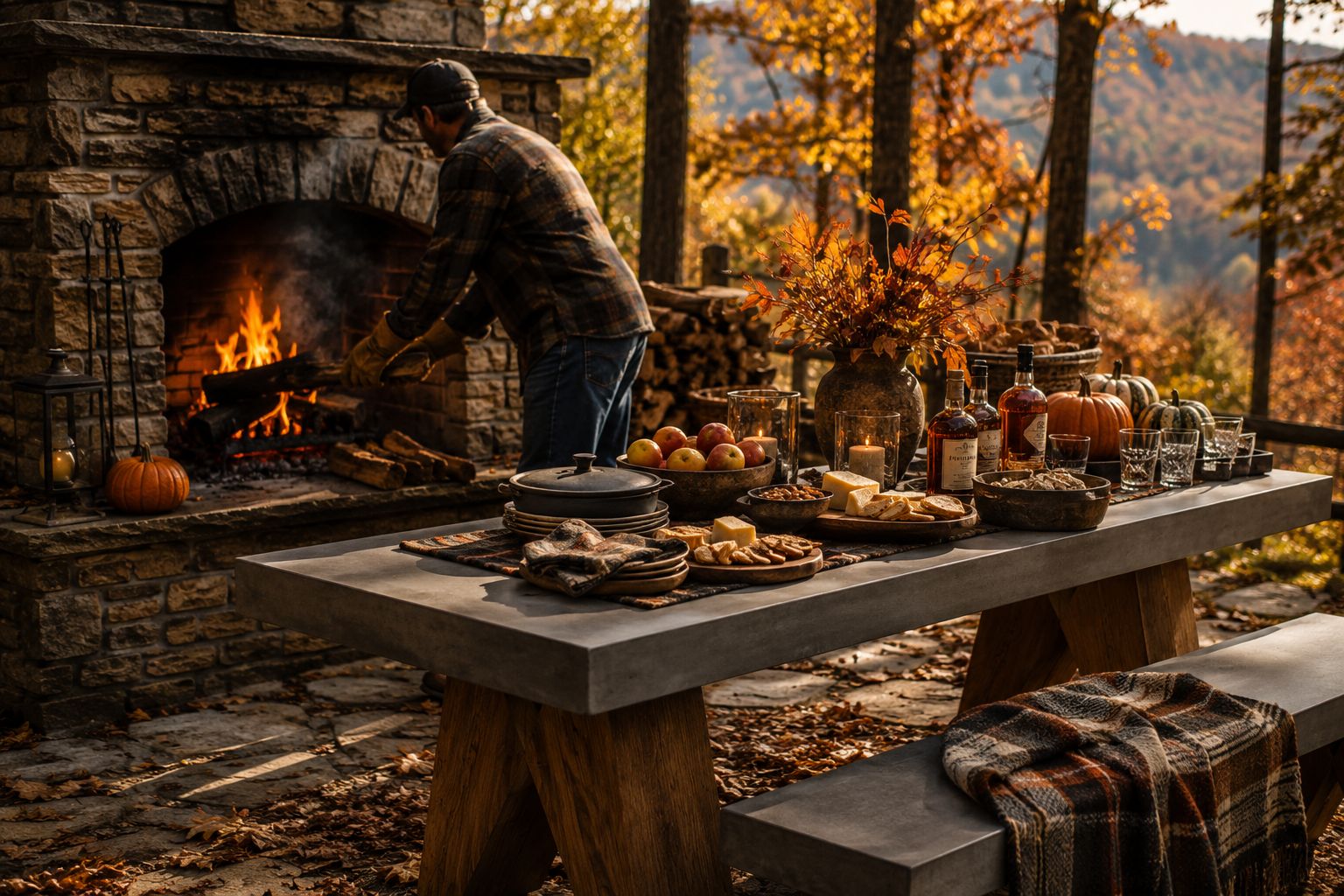
In this setting, the materials around the fire can be elemental without becoming rustic cliché: local stone, weathered timber, iron, wool and concrete. They do not need to imitate the forest. They need enough visual weight to coexist with it.
That is where concrete becomes particularly compelling. Against a Tennessee autumn saturated with orange, russet, gold and red, its quieter mineral surface gives the eye somewhere to rest. Seasonal Living’s Clip Dining Table pairs a silky, Venetian-style concrete top with a base of repurposed reclaimed Indonesian teak. Offered in 87-inch and 118-inch lengths in Slate or Ivory White, with a coordinating 63-inch Clip Bench, it brings a restrained contrast of cool mineral surface and warm wood.
The table is not meant to become the scene. It gives the scene somewhere to happen.
Autumn Has Its Own Appetite
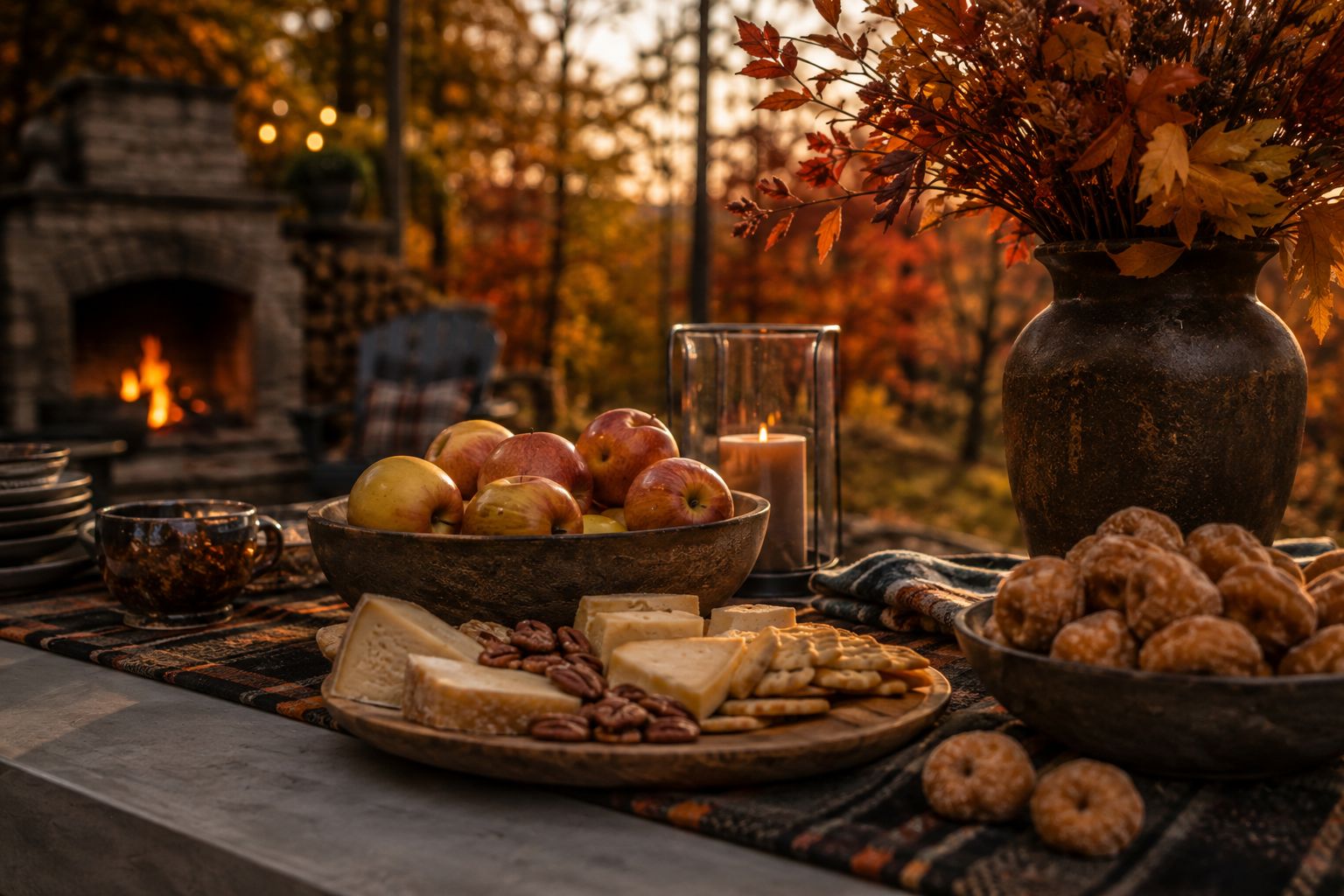
Fall food looks best when it acknowledges the landscape that produced the appetite for it. Apples belong in bowls rather than refrigerated anonymity. Pecans should be cracked. Cheese can be substantial. Bread wants a thick crust. Cider suddenly makes sense again. A few heirloom pumpkins in cream, sage, russet and burnt orange can sit among bowls and platters without turning the table into a harvest display.
The landscape outside is already extravagant, so the table can remain quieter. A folded wool runner softens a concrete surface. Heavy ceramics, wooden boards, clear glass and candlelight add warmth without competing with the view. Food is arranged generously but casually, ready for people to help themselves between conversations.
There is something particularly American about the informality of it. Nobody is waiting to be seated by rank. Someone cuts another piece of cheese, someone refills a glass, someone walks back to the fire and picks up the story that was interrupted five minutes earlier.
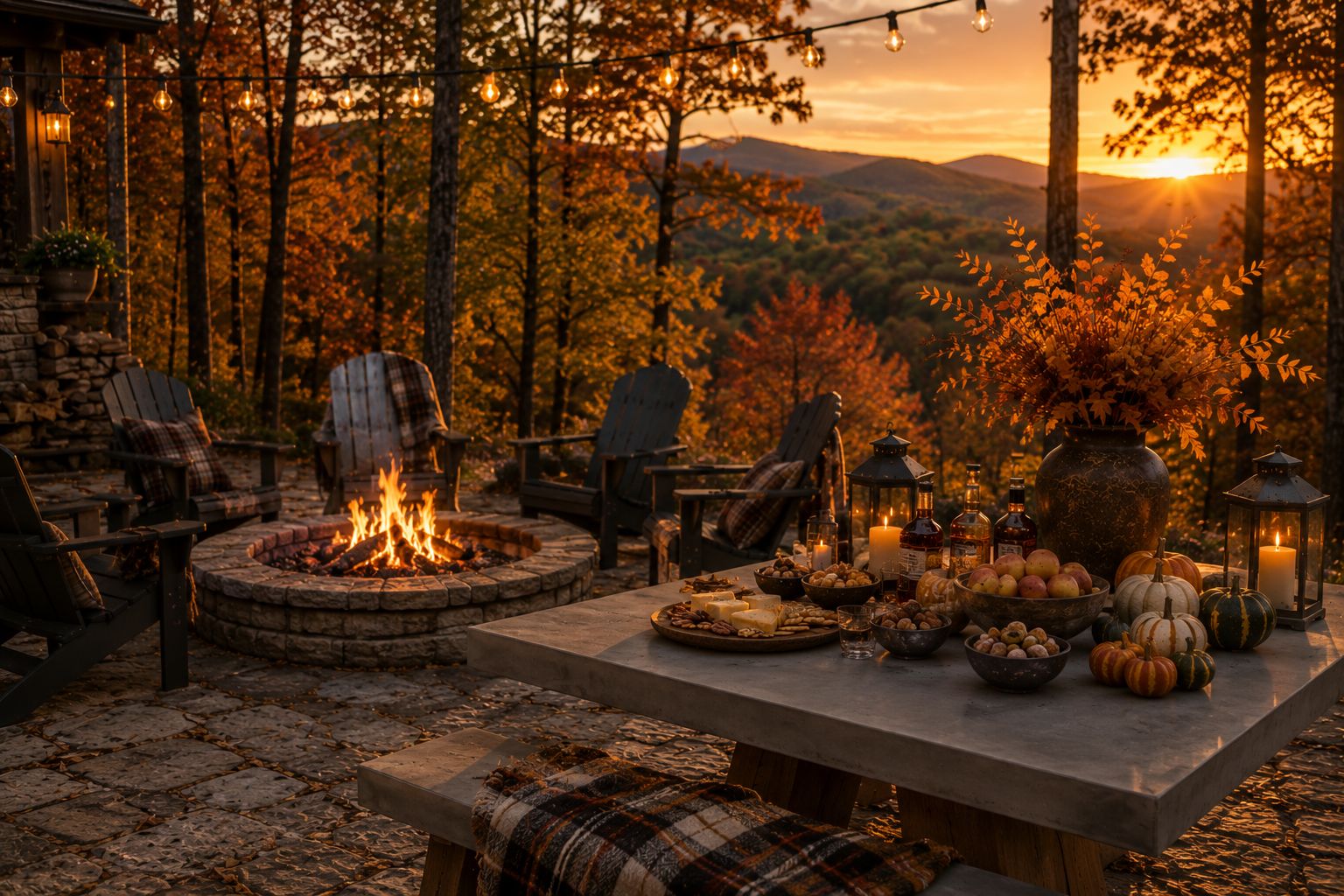
The mountains remain visible through all of it, and that matters. Outdoor entertaining is most convincing when the reason for being outside never disappears beneath the entertaining itself. Here, sunset filters through the trunks, smoke rises and dissolves, lanterns begin to register, and the house behind the gathering starts to glow. The shift from afternoon to evening is gradual enough that nobody announces it.
Cook Where the Fire Is
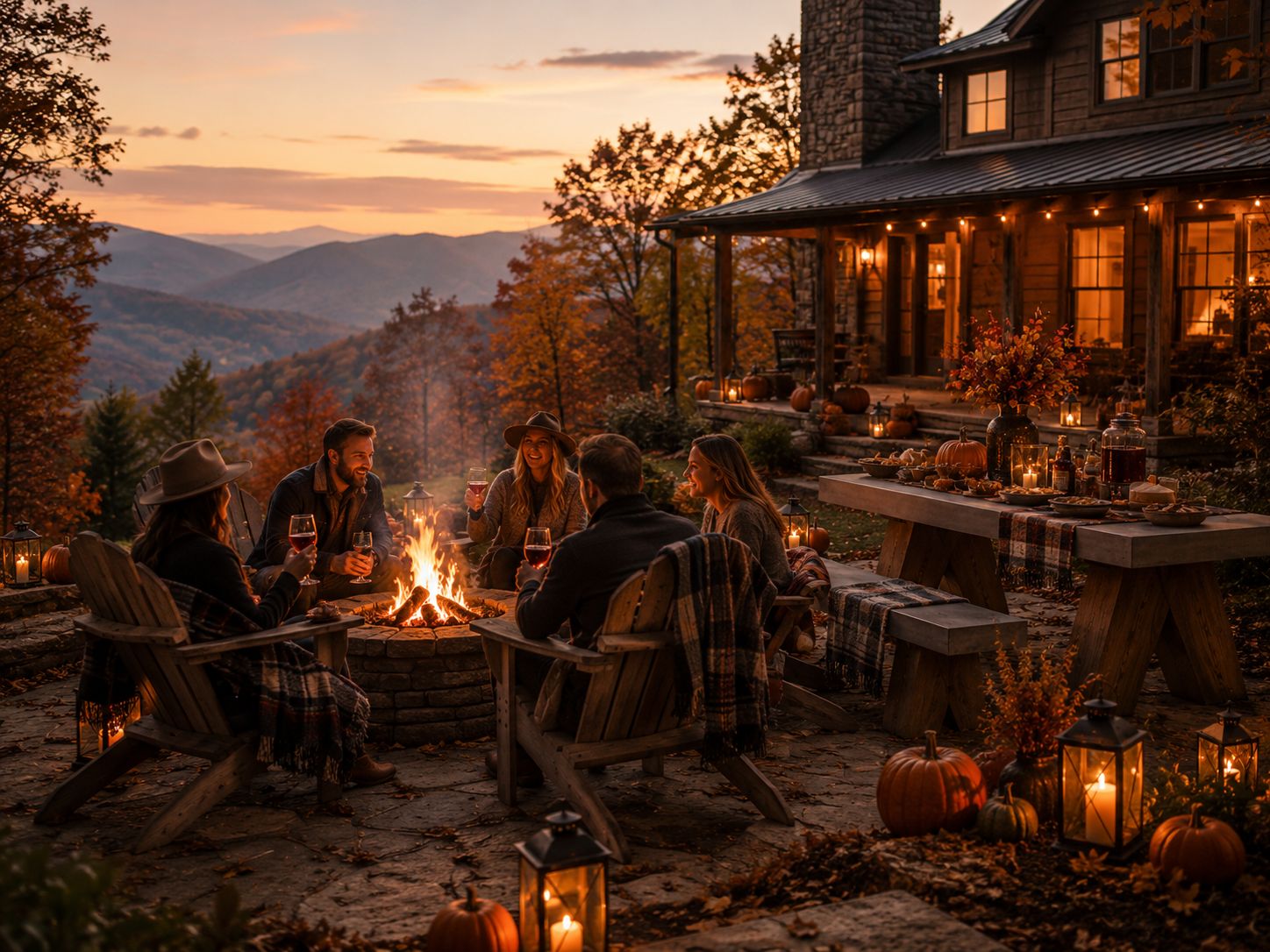
By now, people have stopped behaving like guests and started behaving like a household. They pull chairs closer, carry plates, add wood and move between table and hearth without ceremony. That looseness is exactly what outdoor cooking should encourage.
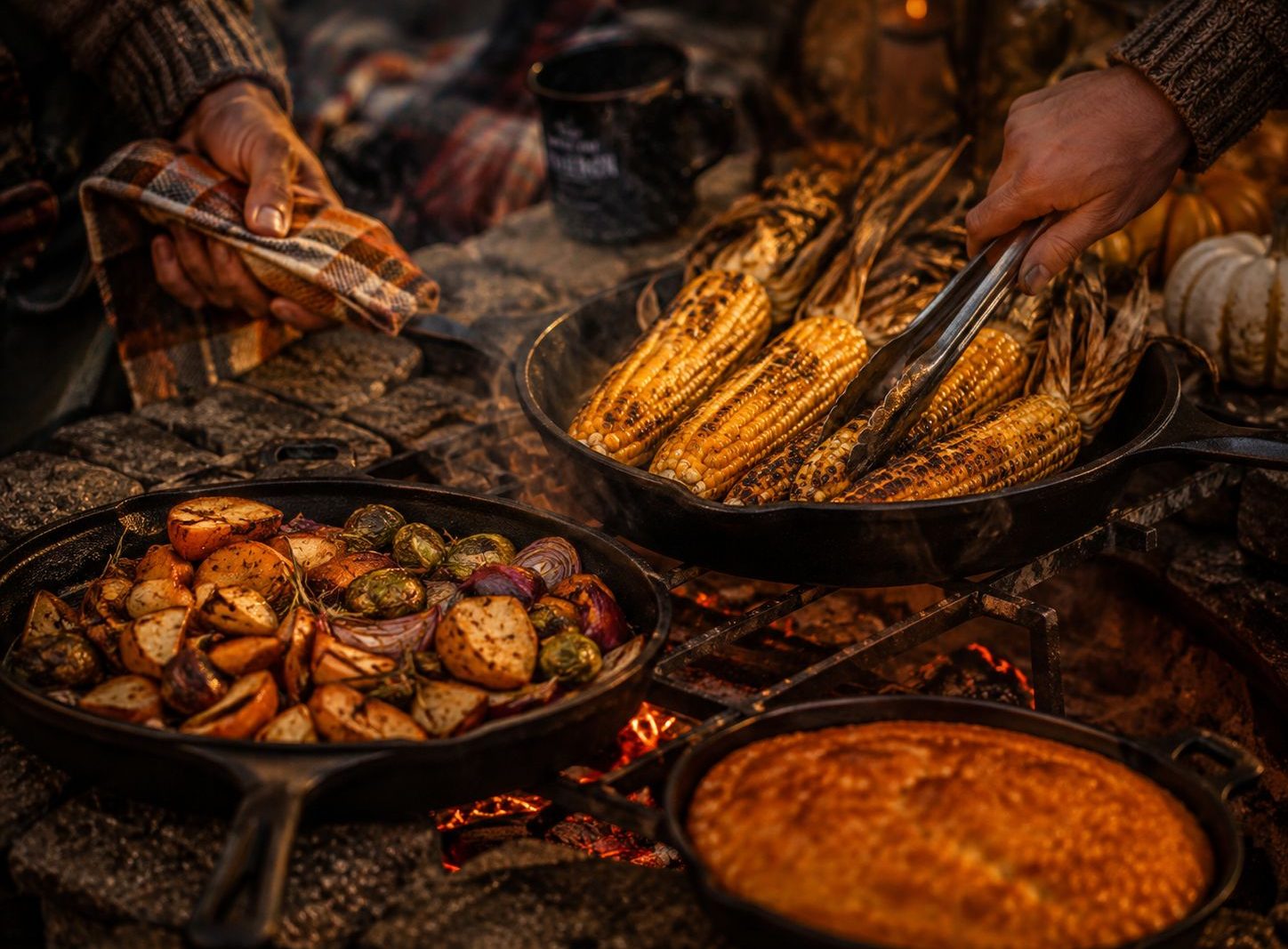
Fire makes food less precious. Cast iron can move directly toward heat. Corn can blister until kernels blacken at the edges. Potatoes and onions roast with herbs until their surfaces caramelize. Brussels sprouts tolerate smoke beautifully. Cornbread cooked in a heavy skillet develops a crisp edge that feels entirely appropriate in the mountain air.
This kind of cooking invites participation. Someone turns the corn, someone lifts a lid, someone wraps a towel around a hot iron handle. Dinner is smelled before it is seen, and the meal becomes less a performance delivered from a distant kitchen than another activity around which everyone gathers. There is pleasure in the slight unpredictability of it. Fire does not consult a timer. Smoke moves where it wishes. One ear of corn chars more deeply than another. Not every meal improves through perfection.
Autumn Changes the Geometry
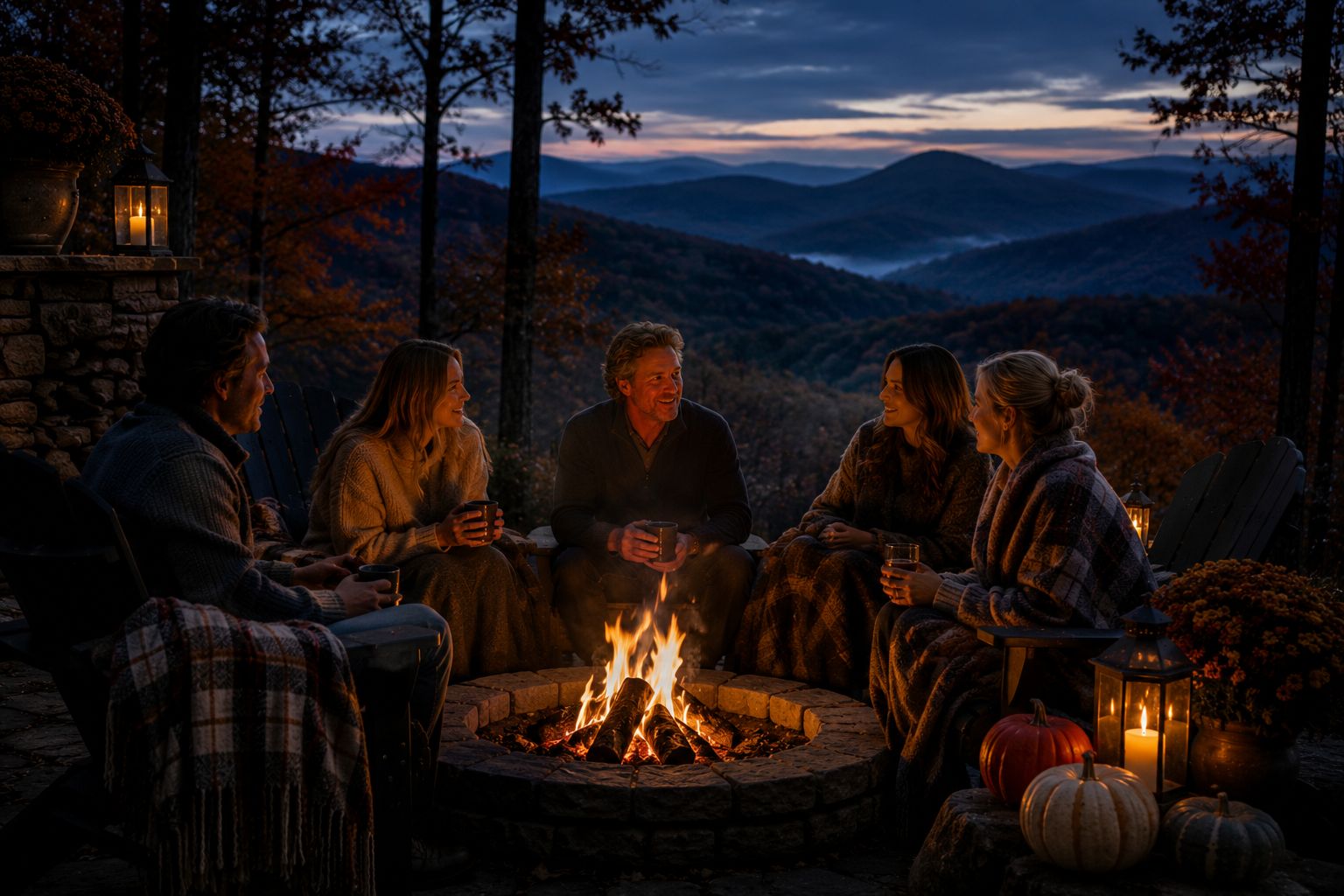
As daylight disappears, something subtle happens to the outdoor room: people move closer. In summer, we instinctively occupy space. Someone wanders toward the view, another remains at the table, another drifts toward the garden. Warmth permits distance. Cold changes the geometry. Chairs rotate toward the fire. Blankets are pulled higher. Conversation contracts into a smaller circle. Beyond that circle, the darkness begins to act almost like another wall, enclosing the gathering without shutting out the mountains.
Designers understand this instinctively. Warmth is not simply temperature; it is proportion, material and light. A substantial hearth gives visual gravity. Timber makes shelter tactile. Wool absorbs light rather than reflecting it. Lanterns create small pools of illumination instead of flattening everything into brightness.
The result is protected without feeling closed — exposed enough to experience the season, sheltered enough to remain within it.
The Luxury of Warm Hands
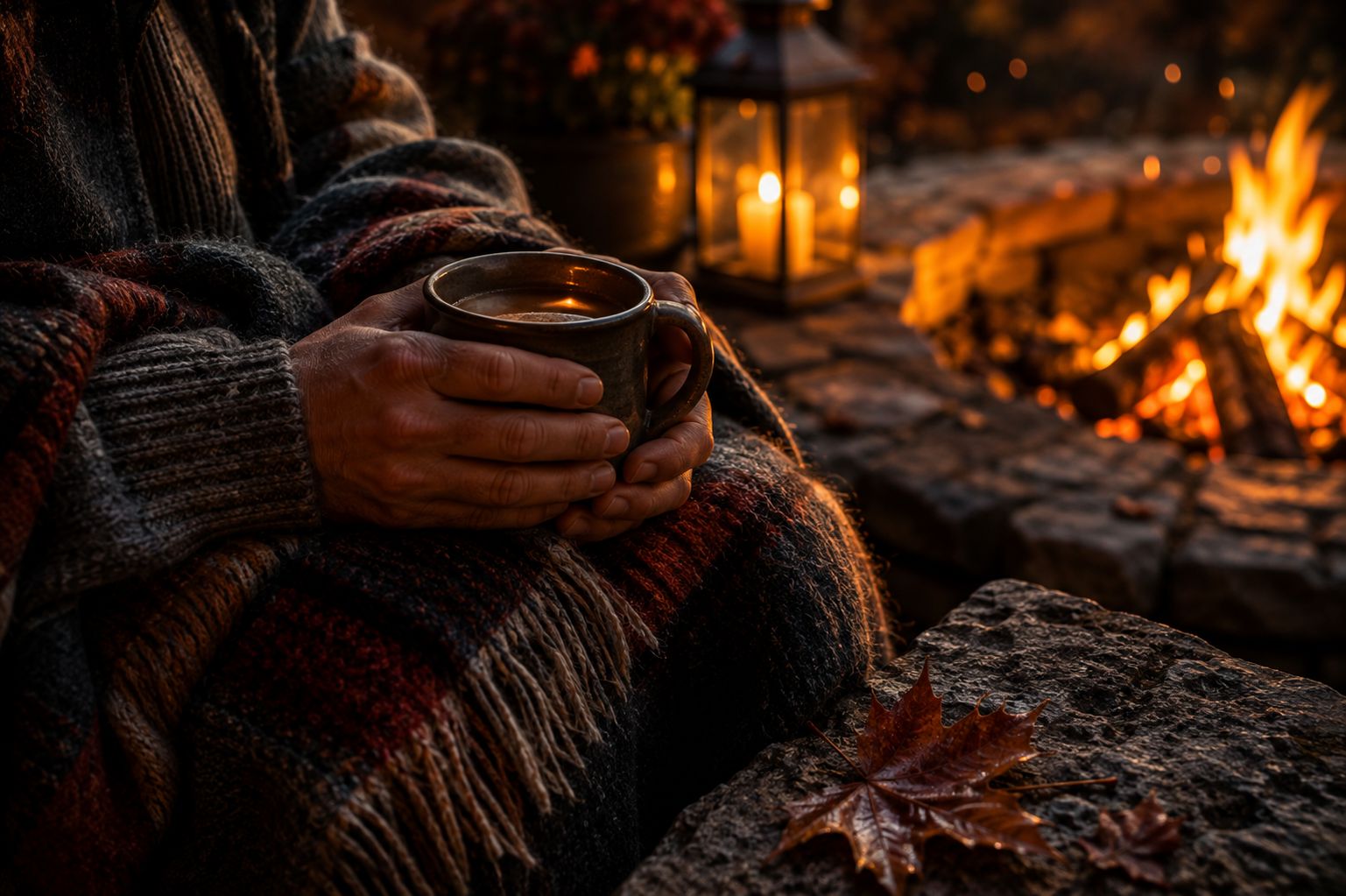
By evening, the entire experience can reduce itself to surprisingly little: a heavy mug between both hands, wool across the knees, rough stone beside the chair, fire warming one side of the body while cool mountain air touches the other.
There is no design vocabulary more persuasive than physical comfort. We can discuss materiality and texture endlessly, but the body reaches its conclusions quickly. Does the chair invite you to remain? Is the blanket within reach? Can a drink be set down without thought? Is the fire close enough to feel, but not so close that you retreat from it?
Comfort is not the enemy of sophistication. Often it is the evidence of it.
The American Porch
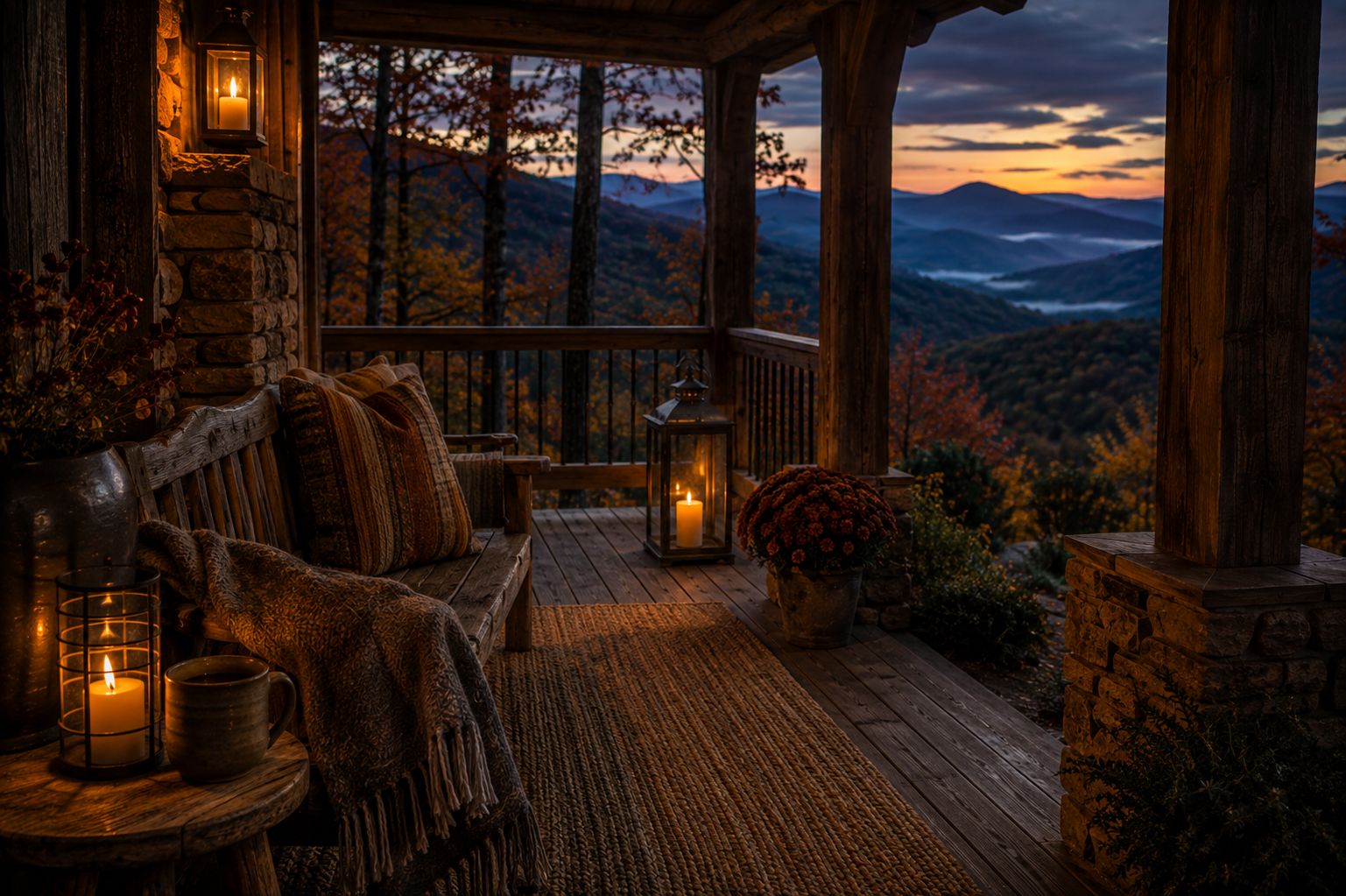
If there is one architectural element made for this season, it may be the porch. The American porch occupies an intriguing territory. It belongs to the house but faces the world. It offers roof without enclosure, furniture without formality, shelter without retreat.
In Tennessee, that in-between quality feels especially powerful. Sit beneath heavy timber while the last mist gathers in distant hollows. A lantern burns beside a bench. A mug gives off steam. Behind you, the interior is warm and illuminated, yet there is no immediate desire to go inside.
This is where indoor–outdoor living becomes more interesting than simply opening a wall of glass. The most successful transitional spaces do not erase boundaries; they make crossing them pleasurable.
The porch lets us inhabit the edge — protected enough to stay, exposed enough to remain part of the season.
When the House Becomes a Lantern
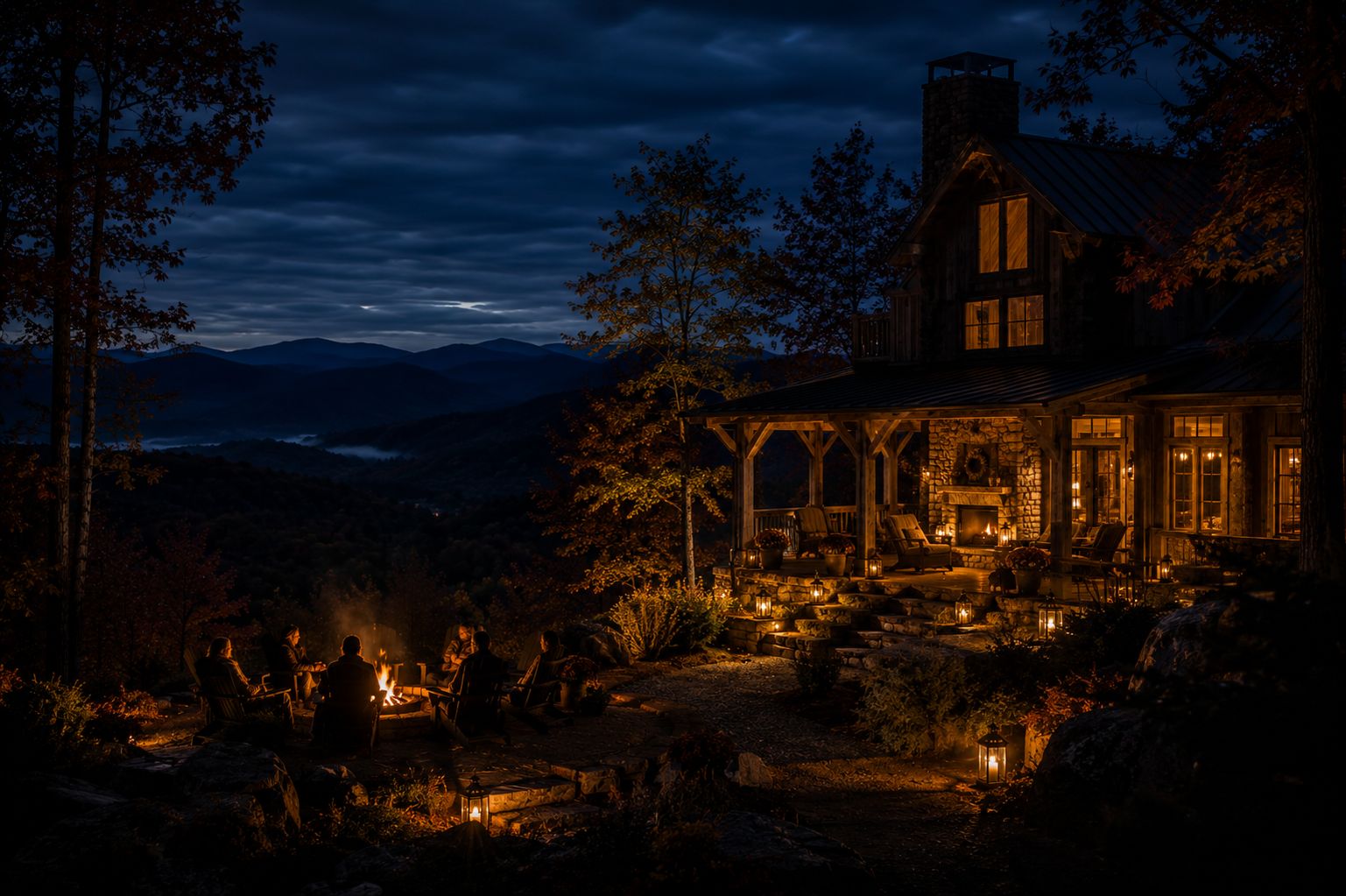
Eventually, the last blue drains from the sky. The ridges become silhouettes and then nearly disappear. The forest that dominated the afternoon recedes into darkness. What remains visible is what human beings have illuminated: a porch, a window, a path, a fire.
From a distance, the house itself begins to resemble a lantern. People gathered around the flames become shapes rather than individuals. The pumpkins beside the steps are barely legible. The details that occupied the afternoon give way to a simpler composition of darkness and warmth. Perhaps that is why autumn gatherings can feel so satisfying. The season performs an editing process of its own. Daylight shortens. The landscape withdraws. The temperature falls. We stop wandering and begin choosing where we want to remain. Usually, that place is somewhere warm, with something to drink and people whose company makes leaving unnecessary.
The Tennessee mountains provide a spectacular setting for this, but the instinct is universal. We build shelter, light fires, gather food and pull our chairs closer together. For all our sophistication, there is something reassuringly ancient about it.
The finest outdoor spaces understand that their job is not to compete with those instincts, but to make room for them.
Autumn does not ask us to retreat from the outdoors. It simply teaches us a warmer way to remain there.
UNTIL NEXT TIME…
Design is more than aesthetics — it’s a seamless continuum that connects the way we live, work, and gather. Explore new perspectives, timeless craftsmanship, and inspired living with us!
Stay connected to the Seasonal Living Design Continuum Journal. Subscribe today to receive our latest journal entries!